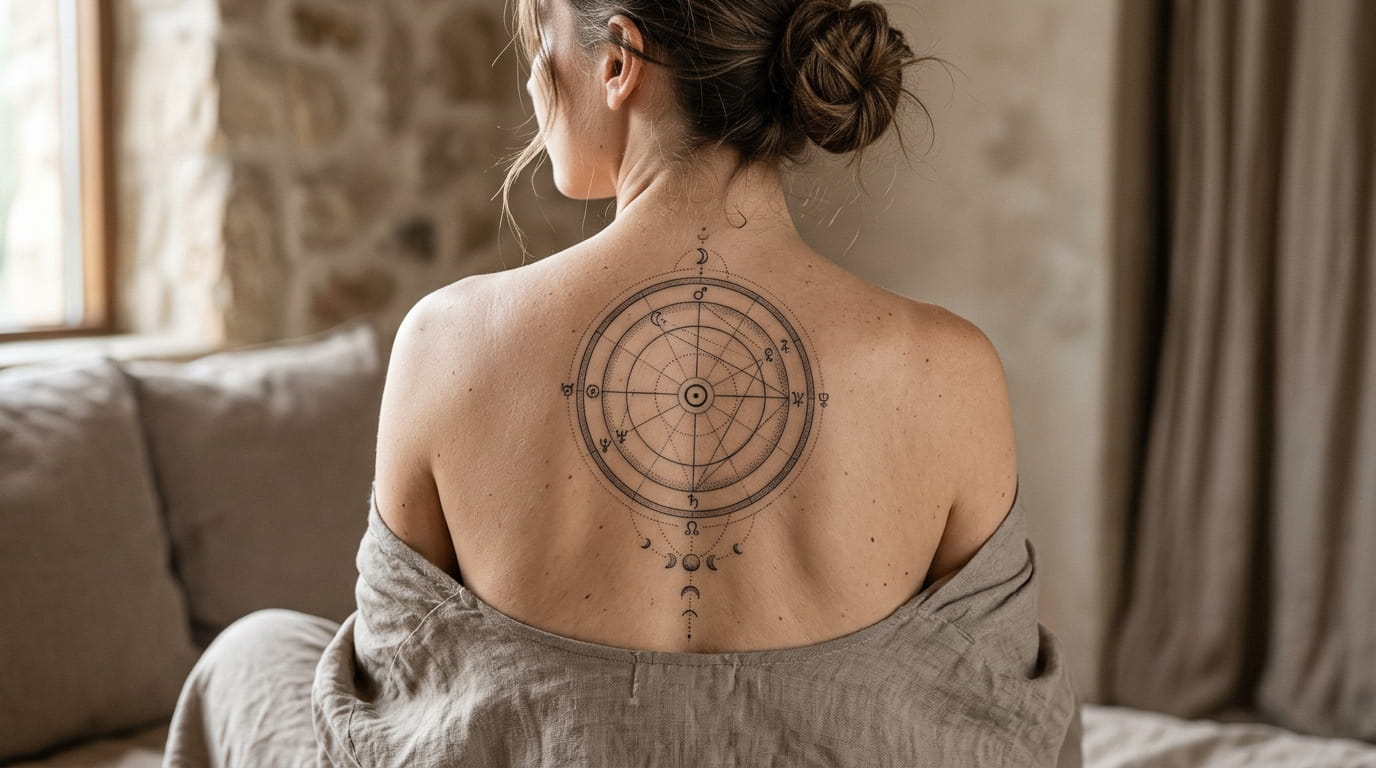
A lot of birth chart tattoos end up looking like something you could find on a flash sheet in any shop, a generic wheel with symbols nobody but you can read. That is not really the point. Your chart is specific. The exact degree your Moon sits at, the house your Venus lives in, the shape of your aspect lines, none of that is random, and a tattoo that ignores it just becomes expensive wallpaper.
The usual advice stops at “get your Sun sign tattooed” or “add a crescent moon.” That skips the real work of translating a chart into something a tattoo artist can draw and you can still recognize in ten years.
This list walks through real birth chart tattoo ideas, from reading your chart correctly before you sketch anything, to choosing a style, to picking the one placement or symbol that carries the most weight. Some ideas are small details. Others change the whole design. Pick what fits the story you actually want on your skin.
1. Pull Your Exact Birth Chart Before You Design Anything

A birth chart tattoo built from a guessed birth time is just decoration. Minutes change your Rising sign, your house cuts, sometimes your Moon sign too, so get the real data before a pencil touches paper.
Pull your official chart from your birth certificate or ask a parent for the exact time, not the general “morning” or “afternoon” people tend to remember. Run it through a real chart calculator, not a one line horoscope app, and save the wheel image your artist can reference directly.
Get your exact birth time from your certificate, hospital record, or a parent who remembers the clock, not just the day.
Enter it into a real chart calculator with your exact birth city, then save the wheel image at full size.
Note your Sun, Moon, Rising, and any planet sitting close to a chart angle, since those usually anchor the design.
2. Pick Your Big Three to Anchor the Tattoo
Three placements can carry an entire birth chart tattoo without it turning into a crowded diagram. Your Sun, Moon, and Rising sign are the shorthand most astrologers reach for first, and they read as personal even to people who know nothing about astrology.
Treat them like a title, not a list. A tattoo artist can turn three glyphs into one tight composition, maybe stacked along a spine or wrapped around a wrist, instead of scattering ten symbols across your forearm.
3. Literal Glyphs or Constellation Art: Choose Your Translation Style
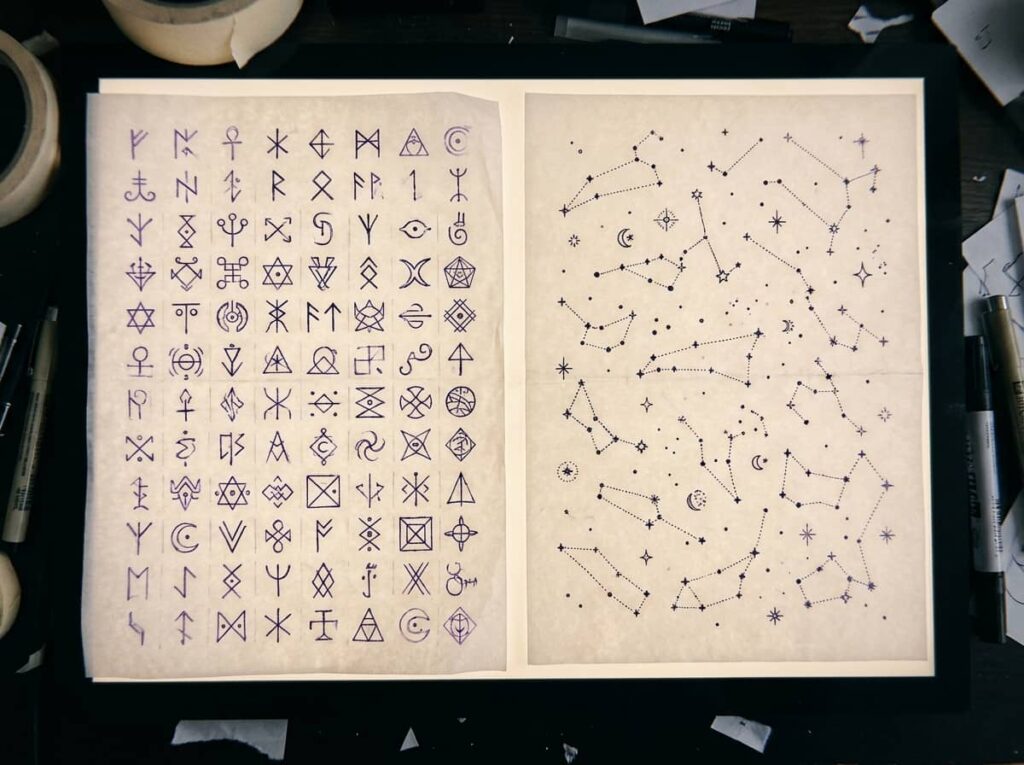
Glyphs and constellation art tell the same story in different handwriting. Glyphs are the small symbolic shapes astrologers already use for planets and signs, clean and compact, easy to tuck behind an ear or along a finger.
Constellation art draws the actual star pattern tied to your sign or a planet’s placement, which reads more like fine art and needs more space to stay legible. Mixing both styles in one piece usually means the busier one wins, so pick a lane before your consult instead of deciding in the chair.
| Glyphs | Constellation Art |
|---|---|
| Small and compact, fits tight spots like a finger or behind the ear. | Needs more room to stay legible, suits a forearm or shoulder. |
| Reads as private, most people will not recognize the symbols. | Reads as fine art, people tend to ask what it means. |
| Best for: minimal, single line pieces. | Best for: a statement piece with real detail. |
4. Chart Wheel to Tattoo Line Art: What Actually Changes
A full chart wheel is packed with twelve house lines, aspect lines crossing in every direction, and tiny glyphs stacked on top of each other. None of that survives well in skin.
A tattoo artist strips it down on purpose. House lines usually disappear first, then minor aspects, leaving only your personal points and the strongest connecting lines. Ask for a simplified proof before the full session, since that is where the design either holds together or falls apart under the needle.
Twelve house lines, dozens of aspect lines, and small glyphs stacked on top of each other.
Just your personal points and the strongest connecting lines, simplified enough to hold its shape for years.
5. Use Your Moon Phase as the Quiet Detail
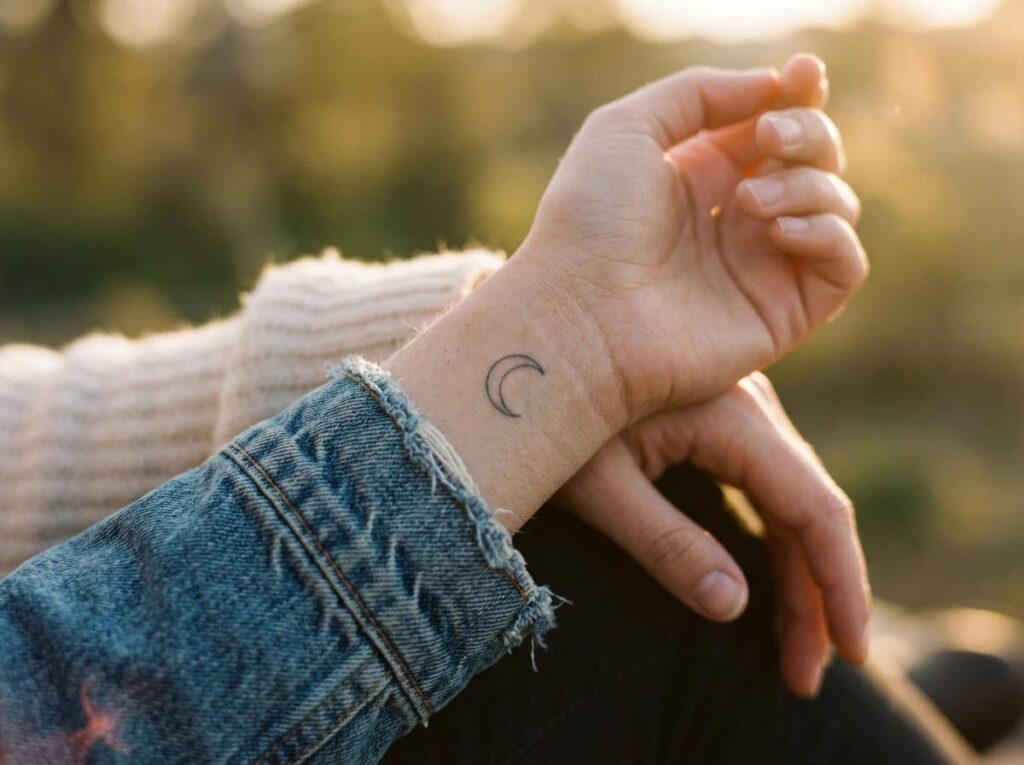
Your birth Moon phase rarely makes it into chart tattoos, which is strange, since it is one of the more personal pieces of data in the whole chart. It is not your sign, it is the exact relationship between the Sun and Moon the moment you were born.
A thin crescent, a waxing gibbous, a dark new moon, each has a distinct shape that works as a small addition tucked near a wrist bone or behind an ear, without competing with the rest of the design.
💡 Quick Tip
Look up your exact Moon phase, not just your Moon sign, using your birth data, then ask your artist to draw that specific shape instead of a generic crescent.
6. One Symbol Can Carry Your Whole Chart
A chart tattoo does not need every symbol to make its point. One glyph, picked for the reason that actually mattered to you, often reads stronger than six crowded together.
Maybe it is your Venus placement because you got the tattoo after a breakup. Maybe it is the exact degree of your Ascendant. Whatever it is, let that single symbol sit with real space around it instead of boxing it in with extra details that dilute the reason you got it.
One meaningful glyph with space around it says more than a crowded chart ever will.
7. Gather These Before Your Tattoo Consult
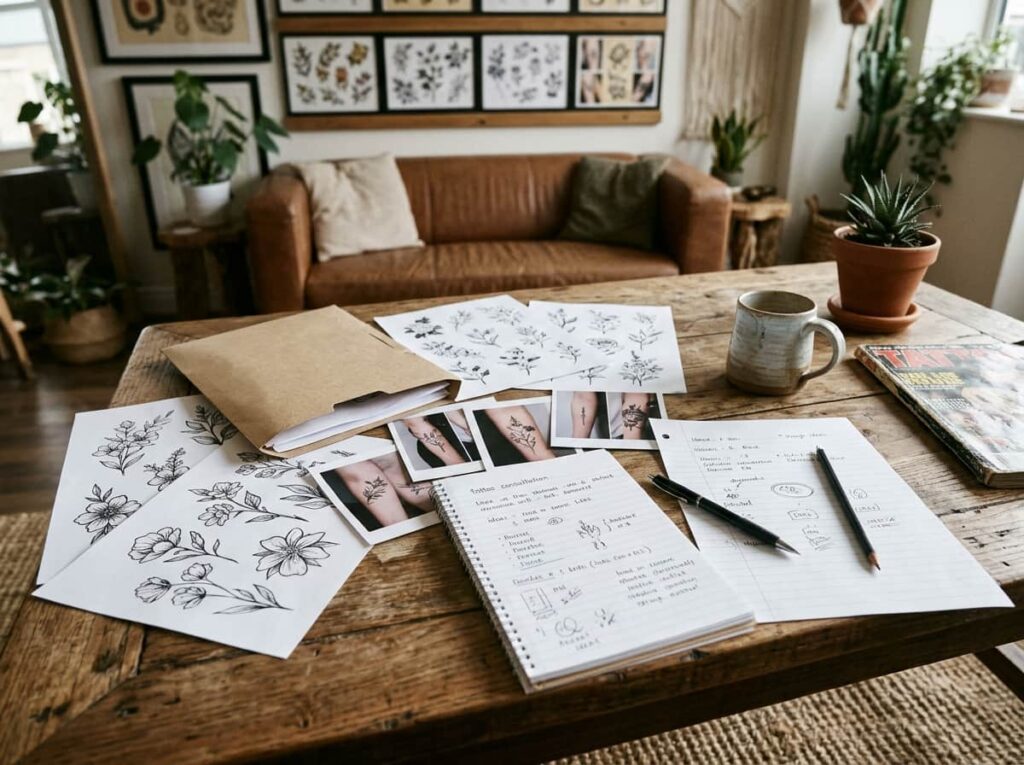
Walking into a consult with just a screenshot of your chart wheel leaves the artist guessing at what matters to you. Bring more than the image.
Put together a small folder, digital or printed, so the artist can see your actual data next to your design references instead of reverse engineering your intent from a cluttered wheel.
What to bring
8. Busy Chart vs Simple Chart: Do This, Skip That
Some charts are naturally busier than others. A lot of close aspects or tight stelliums give you plenty of material, but that is exactly when restraint matters most in the final design.
Let the artist simplify before you fall in love with every line the software drew. A chart that looks impressive on a screen can turn muddy once it is scaled down and inked.
Ask your artist which lines can be dropped without losing the meaning.
Test the simplified version at actual tattoo size before committing.
Tattooing every aspect line exactly as the software drew it.
Approving a design you have only seen full size on a screen.
9. Aspect Lines Add Meaning Most People Miss
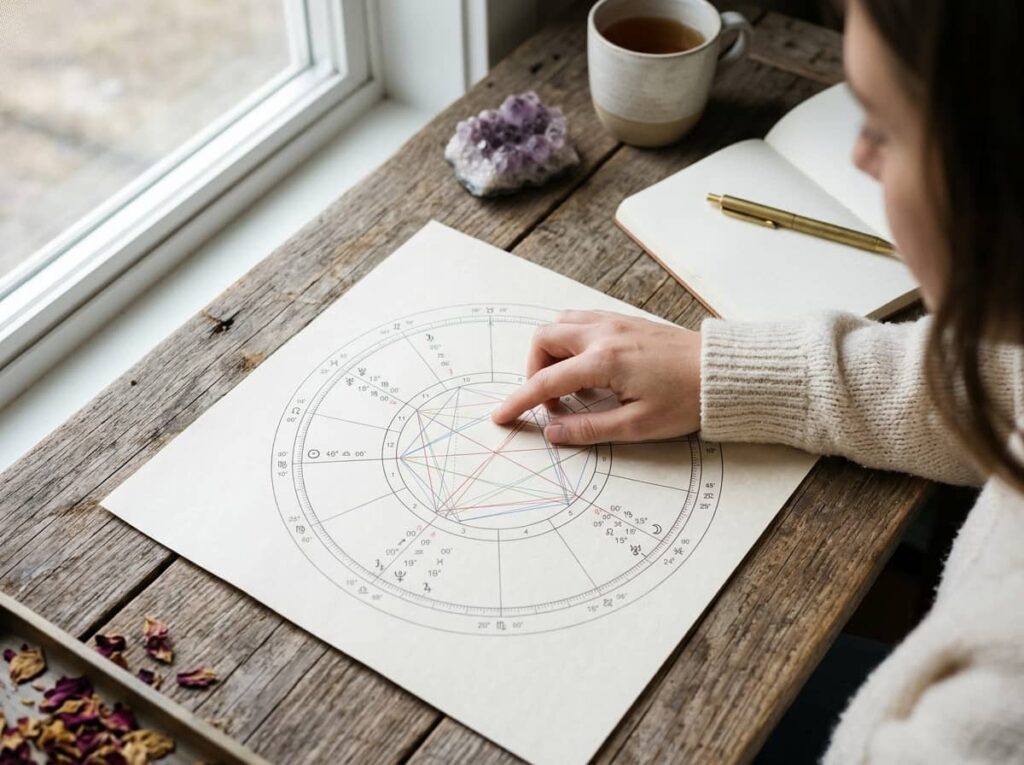
Most people stop at glyphs and skip the lines connecting them, but aspect lines are where a lot of the real story sits. A tight line between your Sun and Moon means something different than one stretching to your Saturn.
A few worth knowing before you sketch anything:
- ▸A conjunction line, two points sitting close together, reads as the tightest connection on the chart.
- ▸A square or opposition line often marks the tension that shaped you most.
- ▸A trine line is the easy, flowing connection, worth keeping if it ties your anchor placements together.
10. Placement Changes What Your Chart Tattoo Says
A chart tattoo on your ribs reads differently than one wrapped around your wrist, even with identical line art. Visible placements turn it into something you talk about. Hidden ones keep it just for you.
11. Watch Out for These Astrology Tattoo Mix Ups
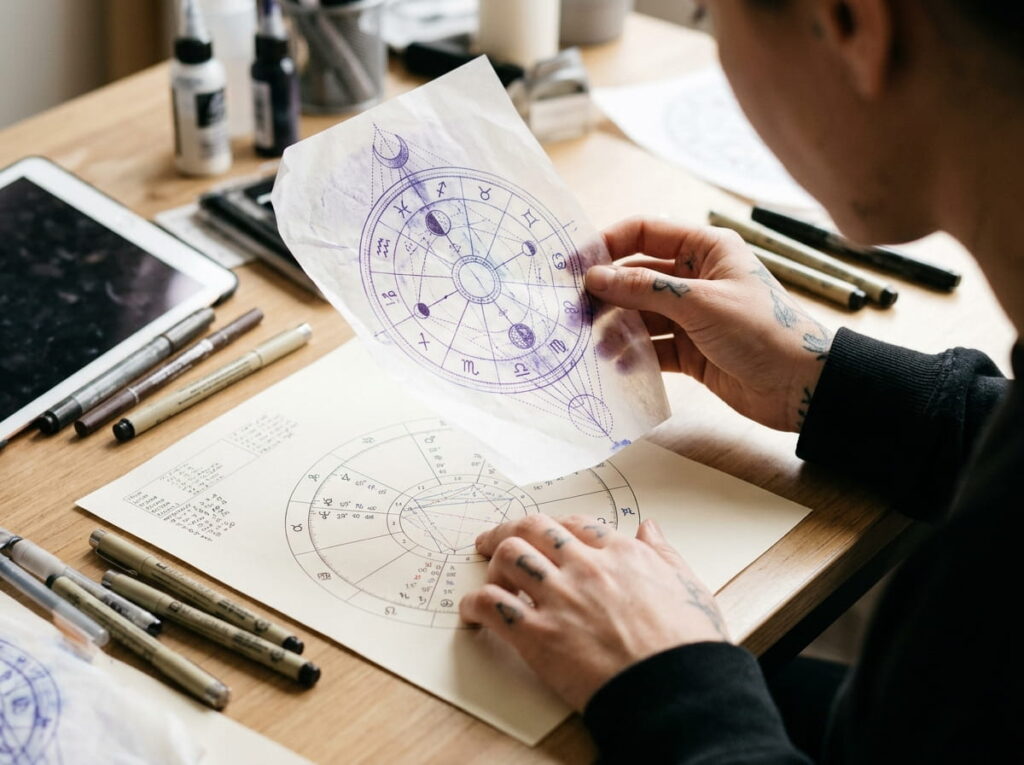
A rushed chart tattoo is where most regrets start. The chart software update, the artist mirrors a glyph without checking it, the client never confirms the final degree placement, small errors that become permanent.
Proof every symbol against your actual chart before the needle touches skin, not after.
⚠️ Watch Out
Glyphs are easy to mirror or flip by accident during stencil transfer. Check the final stencil against your original chart before the artist starts, not after the first line goes in.
12. House Placements Turn Into Body Placement Logic
Some people match where a planet lives in their chart to where its symbol lands on their body. It sounds like a stretch until you see it done well, a 4th house Moon placed near the heart, a 10th house Sun worn high on the shoulder like a small crown.
It is not a rule anyone has to follow, just one more layer of meaning if you want the design to work on two levels at once.
13. Fine Line, Dotwork, or Bold: Match Style to Chart Density
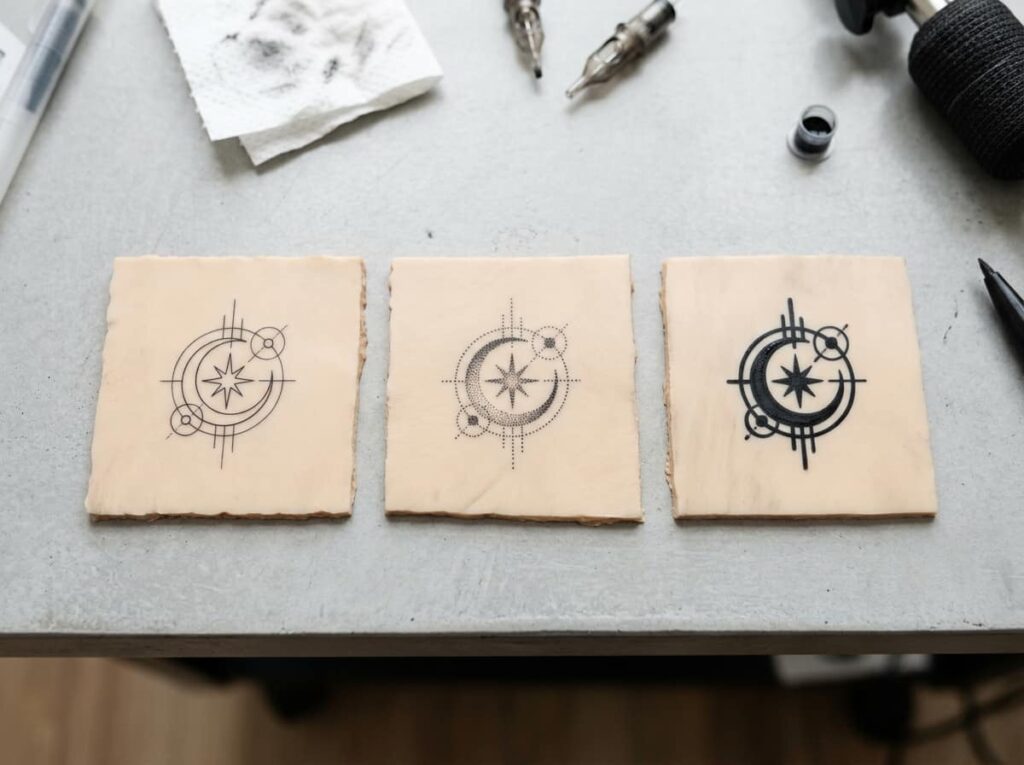
A dense chart with a lot of aspect lines usually falls apart in heavy bold work, the lines bleed together within a few years. A sparse chart with just your Big Three can carry bold linework just fine since there is room for it to breathe.
| Fine Line / Dotwork | Bold Line |
|---|---|
| Best for dense charts with multiple aspect lines and glyphs. | Best for simple designs, just a Big Three or one symbol. |
| Needs more touch ups over time to stay crisp. | Holds its shape longer with less upkeep. |
| Best for: ribs, inner arm, soft skin areas. | Best for: wrist, ankle, areas that see more friction. |
14. The One Symbol to Get Right Before You Commit
Of everything in this list, the degree and sign accuracy of your anchor symbol matters more than the style, the placement, or the size combined. Everything else is a design choice. This part is just correct or not.
Double check the sign, degree, and direction of your anchor symbol against your real chart before the first line goes in.
Conclusion
A birth chart tattoo holds up over time when it comes from your actual data, not a generic zodiac symbol picked off a flash wall. The small decisions matter most: an exact birth time, a simplified line version of a busy wheel, a degree double checked before the needle starts. None of that is extra work for its own sake. It is what makes the tattoo still feel accurate ten years from now.
You do not need every glyph, every house line, every aspect your chart software drew. One well placed symbol, chosen for a real reason, usually says more than a crowded wheel ever could. Whatever direction you take with your birth chart tattoo ideas, let the design stay simple enough to hold its shape.




Leave a Reply