
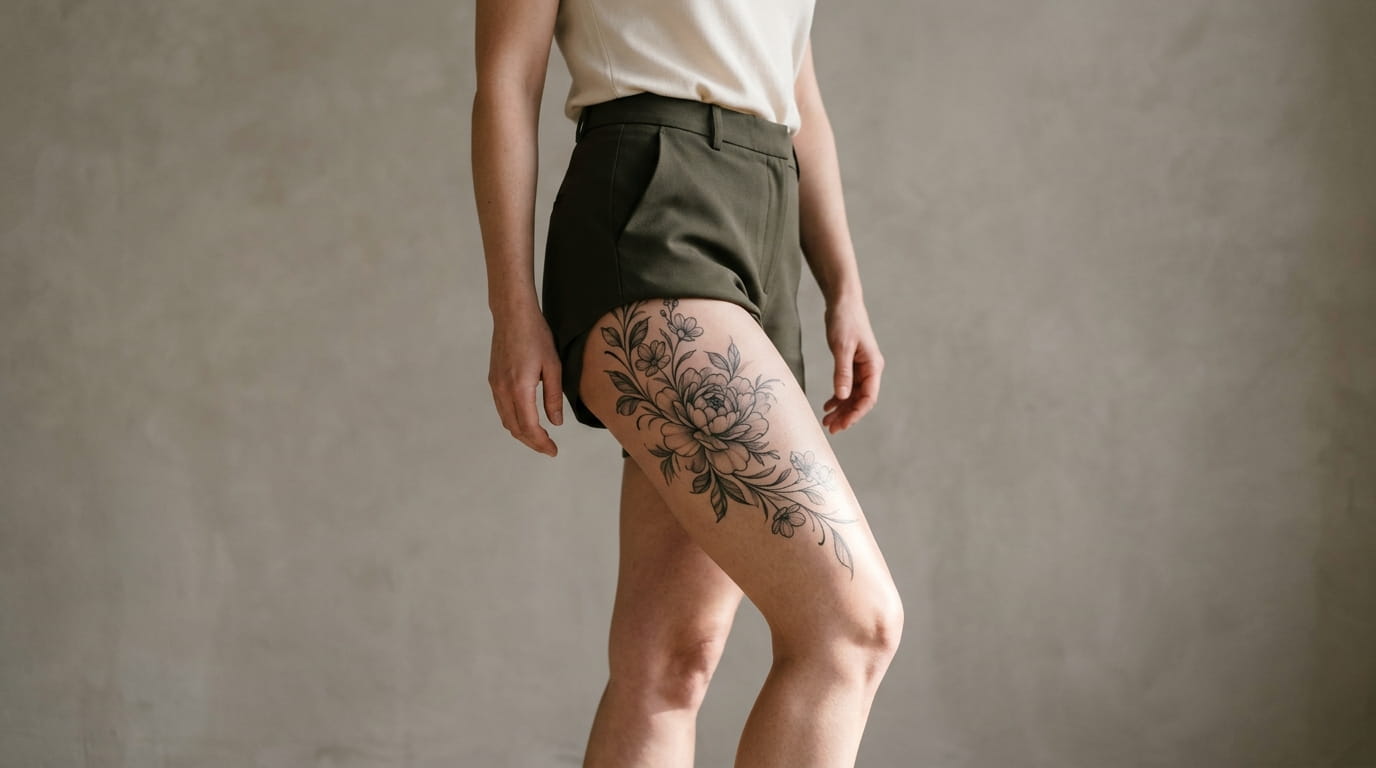
Most people pick a thigh tattoo spot in about five minutes, right before the appointment, and then spend the next year wishing they had thought it through. The front stretches with every big exhale after dinner. The outer thigh shows the second you sit down in shorts. The inner thigh hides from almost everyone but stings the whole session. None of that gets covered when you’re scrolling design ideas instead of thinking about zones.
Thigh tattoo placement actually changes three things at once: how much pain you’re in, how often strangers see it, and how the design reads once your leg is bent instead of standing flat. A piece drawn from a reference photo can look different wrapped around a moving joint.
This list breaks the thigh into its four real sections, front, outer, inner and back, and walks through what each one actually asks of you. No vague “it depends on your style” answers, just the practical trade offs, zone by zone, so you can pick a spot you won’t second guess two months in.
1. Why the Front of Your Thigh Shows Off Detail Best

The front thigh stays mostly flat when you stand, sit, or walk, so fine details hold their shape instead of twisting around the leg.
That matters for linework heavy pieces, florals with thin stems, or lettering you want to stay readable. Two things worth knowing before you commit: the skin here is thinner over the quad, so sessions can feel sharp in short bursts, and it’s one of the easiest spots to cover or reveal with shorts length, which makes it flexible for work dress codes.
If visibility control matters to you as much as the art itself, this zone gives you the most say.
2. Outer Thigh Placement for Bold, Visible Designs
Most outer thigh tattoos end up a little too high, right where a waistband or shorts hem cuts across the design every single day.
Before you lock in placement, do two quick things with your artist. Sit down in jeans and mark where the fabric actually falls on your leg. Then walk a few steps in the mirror to see how the spot shifts when your leg bends.
The outer thigh also has more surface area than people expect, so a piece that looks small on paper can read as a full panel once it’s scaled onto the leg.
💡 Quick Tip
Bring the shorts or jeans you wear most to your consult so your artist can mark placement around the fabric line, not just the bare leg.
3. Inner Thigh Tattoos and What That Privacy Actually Costs

People assume inner thigh placement is only about hiding a tattoo, but privacy is really just one side effect of the skin itself.
This area has less fat padding and sits closer to friction from walking, which changes both the pain and the healing. It also means fine detail can soften a little faster over the years compared to a flatter zone like the front thigh.
That doesn’t rule it out. It just means the decision should be about the skin, not only about who gets to see it.
Choose bolder linework that can handle some softening over time.
Plan for a longer healing window and loose clothing.
Very fine, thin line detail that depends on crisp edges.
Tight, skinny jeans in the first two weeks of healing.
4. Back of Thigh Placement for a Design Only You Choose to Reveal
You’ll likely never see a back of thigh tattoo without a mirror and a bit of effort, which is exactly why a lot of people choose it.
It stays private under nearly everything you wear, including most swimwear, and it rarely shows up in day to day photos. The one trade off is session comfort. Lying face down or on your side for an hour is a different experience than sitting upright, and the design needs to still make sense from an angle you’ll rarely see straight on.
Before you book this spot
5. How Pain Level Changes Across the Four Thigh Zones
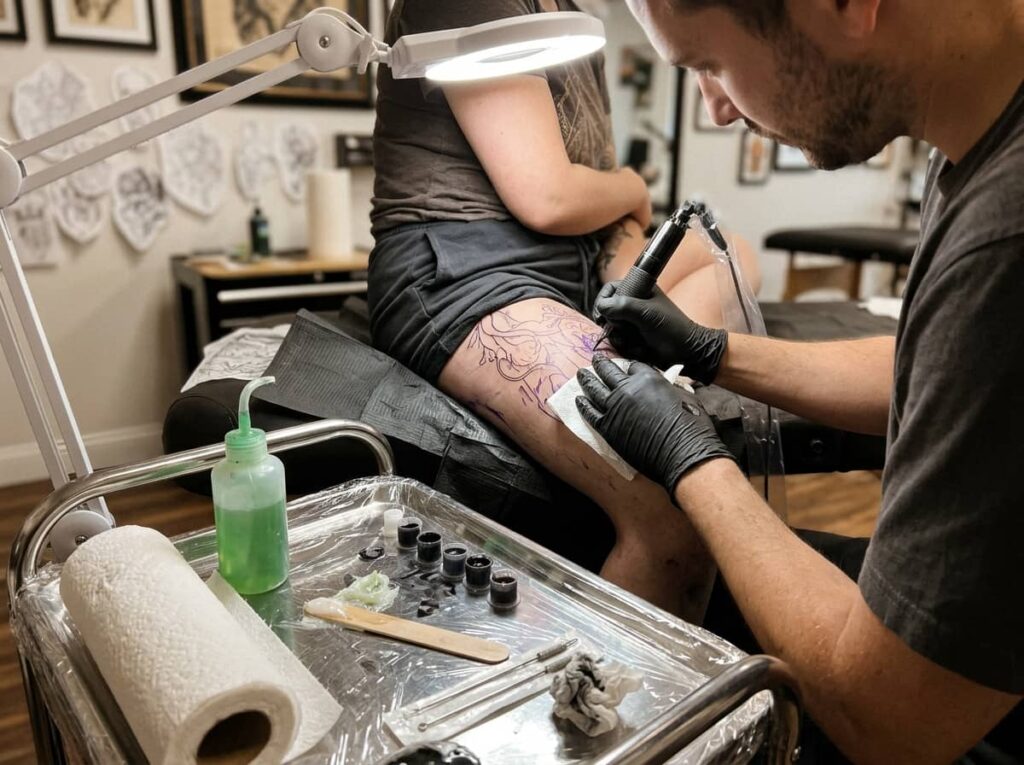
Pain isn’t one question across the thigh, it really splits into two factors: how thick the skin is and how close the needle gets to bone or nerve clusters.
The front and outer thigh tend to feel more consistent since there’s more muscle and fat underneath. The inner thigh and the area near the knee are where most people report sharper, more localized pain. None of this is exact science, bodies vary a lot, but it’s a reasonable starting point before you commit to a multi hour session.
6. Matching Tattoo Shape to Natural Thigh Curves
A straight geometric design and a flowing organic one behave completely differently once they sit on a curved leg instead of a flat sheet of paper.
Angular pieces, like sharp geometric patterns or bold lettering, tend to need a flatter zone such as the front or back thigh to keep their lines crisp. Curved, organic designs, like florals or flowing script, often work better wrapped around the outer or inner thigh because the body’s natural shape becomes part of the composition instead of fighting it.
Ask your artist to sketch directly on your leg before the session, not just on paper.
| Angular Designs | Curved Designs |
|---|---|
| Best on flatter zones like front or back thigh | Best on curved zones like outer or inner thigh |
| Holds straight lines and sharp edges well | Uses the leg’s natural shape as part of the flow |
| Can look stiff if forced onto a curved area | Can look busy if forced onto a flat panel |
7. What a Thigh Tattoo Really Looks Like Once You Sit Down

A design that looks balanced on a reference photo of a standing leg can shift entirely once you sit, cross your legs, or bend your knee.
Skin folds, muscle shape changes, and the spacing between elements compresses or stretches depending on your position. This is especially true for pieces that span a wide area, like a thigh to hip design, where the top and bottom can end up visually disconnected once you’re seated.
A good artist will ask you to sit during the stencil placement, not just stand.
Design looks evenly spaced and fully visible along the leg.
Spacing compresses, and elements near the hip or knee can shift or overlap.
8. Wrap Around Designs That Cross More Than One Thigh Zone
Wrap around pieces that travel from the front to the outer thigh, or the outer to the back, need more planning than a single zone design.
Here’s a simple way to approach it with your artist.
Mark where each zone starts and ends while standing and while sitting.
Ask your artist to place the busiest part of the design on the zone that stays flattest.
Plan for a longer session, since wrap designs often take more than one sitting.
A wrap around piece can be one of the most striking choices on the leg, but only if the transition between zones was mapped out ahead of time instead of eyeballed in the chair.
9. Letting Your Wardrobe Decide Where the Tattoo Goes

Think about the three outfits you wear most before you think about the design itself.
If most of your wardrobe sits at the knee or longer, a front or back thigh tattoo stays private without any real effort. If you live in shorts and swimwear, outer thigh placement means the piece gets seen constantly, which changes how much thought you might want to put into something that visible.
Your closet already tells you how visible this tattoo will be, so check it before you check the design.
10. Thigh Placement for Pieces That Connect Up to the Hip
A tattoo that extends from the thigh up to the hip changes the whole conversation around placement, because now two very different skin types and movement patterns are involved.
A few things worth weighing before you commit to this scale:
- ▸Hip skin tends to be more sensitive than the outer thigh, so pain can increase as the design climbs upward.
- ▸Waistbands and underwear lines will sit directly across part of the piece.
- ▸Larger connected pieces usually mean multiple sessions spaced weeks apart.
This placement works best for people who already know they want a bigger piece, not for a first tattoo.
11. Why Leg Shape Changes How a Placement Actually Reads

The same exact design can look completely different depending on whether it sits on a leg with more muscle definition, more curve, or a straighter line from hip to knee.
A design built for an athletic leg often uses the muscle lines as part of the layout, letting shading follow the natural contour. A curvier leg gives more room for larger pieces to wrap smoothly without looking stretched. A straighter leg shape tends to favor simpler, more vertical compositions that don’t rely on curves to look balanced.
None of this means one body type is more or less suited to any zone, it just changes how the artist should approach the stencil.
12. Choosing Placement Based on How Often You Want It Seen
Some people want their tattoo seen every day. Others want it to stay a quiet, personal thing. Both are completely valid reasons to pick a zone.
If you want it visible often, outer or front thigh placement works with most everyday clothing. If you’d rather keep it mostly private, inner or back thigh placement means you control exactly when and to whom it’s shown.
📌 Good To Know
There’s no rule that says a bigger or bolder piece has to go somewhere visible. Plenty of large, detailed work lives quietly on the back or inner thigh.
13. Front vs Outer Thigh: Picking Between the Two Most Requested Spots

These two zones get requested the most, and it’s easy to assume they’re basically interchangeable. They’re not.
The front thigh stays flatter and shows detail more consistently, but it’s also more exposed when you sit with your legs apart. The outer thigh has more surface area for a sweeping design, but waistbands and shorts hems cut across it more often than people expect.
You want crisp detail that holds its shape.
You’re comfortable with it showing when seated.
You want a larger, sweeping design.
You’re fine planning around waistbands and hemlines.
14. How Movement and Muscle Flex Affect Placement Choice
Walk up a flight of stairs or squat down, and watch how much your thigh actually moves. That motion matters more than most people think when choosing placement.
Zones with more muscle flex, like the front and outer thigh during a squat, can distort fine linework slightly during motion even after full healing. Zones with less flex, like the back of the thigh, tend to hold their shape more consistently through daily movement.
Before your appointment, run through this short check:
Movement check before you commit
Final Thoughts
Thigh tattoo placement really comes down to three honest questions: how much movement the zone sees, how often you want it visible, and whether the design shape matches the leg’s natural curve. Front and outer thigh give you detail and visibility. Inner and back thigh give you privacy and quiet control. None of these zones is the “right” one, they just serve different goals.
Sit with these fourteen angles before your next consult, bring real photos of how you move and dress, and let your artist place the stencil on a body that bends, not just a flat reference sheet.






Leave a Reply