Most tattoo advice stops at “pick something that speaks to you,” which sounds nice until you’re staring at a blank page trying to turn a feeling into a shape. That’s the real problem. You don’t need more inspiration photos. You need a way to test whether a symbol is actually yours, or just something you saw scrolling at midnight.
This worksheet-style guide walks you through how to choose a meaningful tattoo one small decision at a time. Instead of asking you to find your aesthetic, each step hands you a specific question to answer on paper: what the symbol means to you, who else might read it differently, where on your body it’s allowed to speak loudly or stay quiet.
By the end, you won’t have a mood board. You’ll have a one-page answer key for the design you actually book, built from your own chapters instead of someone else’s Pinterest board.
1. Start With the Feeling, Not the Image Yet

Before you look at a single picture, name the feeling first.
Not the subject, not the style, just what you want to feel when you look at your arm in ten years. Safe. Proud. Less alone. Write that word down before you open Pinterest, because images have a way of borrowing other people’s meanings before you’ve locked in your own. The feeling is your filter. Everything else, the animal, the flower, the line art, gets tested against it later.
💡 Quick Tip
Write your one word feeling on a sticky note and keep it next to every design you consider. If a design doesn’t match the word, it’s not the one yet.
2. List the Life Chapters You’d Still Want to Carry in 10 Years
Grab a sheet of paper and write down five chapters of your life you’d stand behind even on a hard day. Not highlights reel moments, the ones that actually shaped you.
A move you survived. A person you miss. A version of yourself you had to let go of. Read the list back. The chapter that gives you a physical reaction, a tightness in your chest or a small smile, is the one worth symbolizing. Everything else can stay in your journal instead of on your skin.
3. Split Grief Symbols From Decoration Symbols First
A lot of people assume every meaningful tattoo has to carry grief, but that’s not true, and mixing up the two categories is where regret usually starts.
A memorial symbol holds a specific person, date, or loss. A decorative-but-personal symbol holds a value or a season of life, no single person attached. Both are valid. Blend them and you risk a tattoo that feels like it’s explaining two different people at once.
| Memorial Symbol | Decorative Symbol |
|---|---|
| Tied to one specific person or date. | Tied to a feeling, value, or season of life. |
| Often chosen to stay private or close to the body. | Placement can be bolder or more visible. |
4. Write the Meaning in One Sentence Before You Sketch Anything
If you can’t explain your tattoo in one sentence, the design isn’t finished yet, the thinking is.
Try this: “This symbol represents ___ because ___.” If you’re reaching for three clauses and a story with a beginning, middle, and end, simplify further. The best meaningful tattoos survive being explained to a stranger at the pool in under ten seconds. That’s not shallow, it’s clarity, and clarity is what keeps you from regretting the design five years from now.
If the meaning takes more than one sentence to explain, simplify the symbol until it does.
5. Run the Stranger Test on Your Symbol

Somebody at the grocery store is going to ask about your tattoo eventually, usually while you’re holding frozen vegetables and not in the mood for a deep conversation.
Think through how you’d answer them in one casual sentence. If the honest answer feels embarrassing, too private to share, or like it needs a disclaimer, that’s useful information. It doesn’t mean skip the tattoo. It means you’ve found a symbol built for a quieter kind of meaning, better suited for placement somewhere only you choose to show.
Before you commit, ask yourself
6. Catch the Symbols That Only Make Sense This Week
Here’s a quick gut check: would this symbol have meant anything to you two years ago?
If the answer is no, slow down. A breakup, a trend, a show you just finished watching: all of these can feel permanent at 11pm on a Tuesday and forgettable by spring. That doesn’t make the feeling fake, it makes it recent. Recent isn’t the same as rooted. Give anything tied to a current event, relationship, or phase at least one full season before you book it.
Wait out at least one full season on anything tied to a recent event.
Ask if the meaning still holds without the backstory attached.
Booking an appointment during the first week of a big feeling.
Choosing a symbol only because it matches someone else’s current situation.
7. Check What the Symbol Means in Other Cultures First

A symbol can carry one meaning in your head and a completely different one somewhere else, and that gap is worth closing before you commit.
Certain flowers, animals, and geometric patterns are sacred, religious, or specific to a culture you don’t belong to. Using one without knowing its full weight can turn a personal tattoo into an uncomfortable conversation later. A ten minute search on the symbol’s history across a few cultures can save you from a design you’d otherwise have to explain or cover.
⚠️ Watch Out
If a symbol belongs to a specific culture or faith you’re not part of, treat that as a sign to keep researching, not a reason to stop looking entirely.
8. Weigh Literal Against Abstract Before You Decide
Literal symbols say exactly what they mean. A portrait, a name, a specific date. Abstract symbols carry meaning through shape instead of subject, a certain line, a geometric form, a single dot.
Neither is better. Literal ages well for people who like clarity and don’t mind the story being obvious. Abstract ages well for people who want the meaning to stay private, known only to them. Sit with both options for your chosen chapter and notice which one makes you feel more at ease, not more impressed.
9. Match the Placement to What the Symbol Is Allowed to Say

Placement decides how loud your symbol gets to be, and that’s worth planning before you pick a design, not after.
A forearm piece gets seen in every meeting and every summer photo. A rib or ankle piece only speaks when you choose to let it. If your symbol is something you want to explain often, place it somewhere visible. If it’s something you’d rather protect, place it somewhere quieter. The design and the placement should agree with each other.
| Visible Placement | Private Placement |
|---|---|
| Forearm, hand, neck. | Ribs, upper thigh, behind the ear. |
| Good for stories you want to share. | Good for meanings you want to keep close. |
10. Turn Your Mood Board Into a Feeling Board
Most mood boards are full of pictures that look good together but don’t actually mean anything together, and that’s the trap.
Go back through yours and delete anything you saved because it was pretty, not because it connected to your chapter from step two. What’s left is smaller, but it’s honest. This is the board that should guide your artist’s sketch, not the one with forty pins and three different animals that have nothing to do with your actual story.
A crowded board of forty pretty images with no clear thread between them.
A short list of images that all trace back to the same one-sentence meaning.
11. Build Your Shortlist With a Three-Question Filter
By now you’ve probably got three or four designs still in the running, which is a good problem to have but still a problem.
Ask the same three questions of each one: Does it match my one word feeling from step one? Could I explain it in one sentence? Would it still matter without the current context around it? The design that answers yes to all three without hesitation is your shortlist winner. If two designs tie, sleep on it for a week before deciding.
The three-question filter
12. Spot the Difference Between Trendy and True
A symbol can be everywhere on social media and still be exactly right for you, so trendy isn’t automatically a red flag. The problem is when trendy is the only reason it’s on your list.
Test it by covering up the source. If you first saw this symbol on someone else’s arm last month, ask whether you’d have landed on it yourself without that spark. True symbols usually trace back to your own chapter from step two. Trendy symbols usually trace back to a feed.
Trace the symbol back to your own list of life chapters.
Ask if you’d have chosen it without seeing it online first.
Choosing a design only because it’s having a moment.
Assuming popular automatically means personal.
13. Give the Design a Waiting Period Before You Book
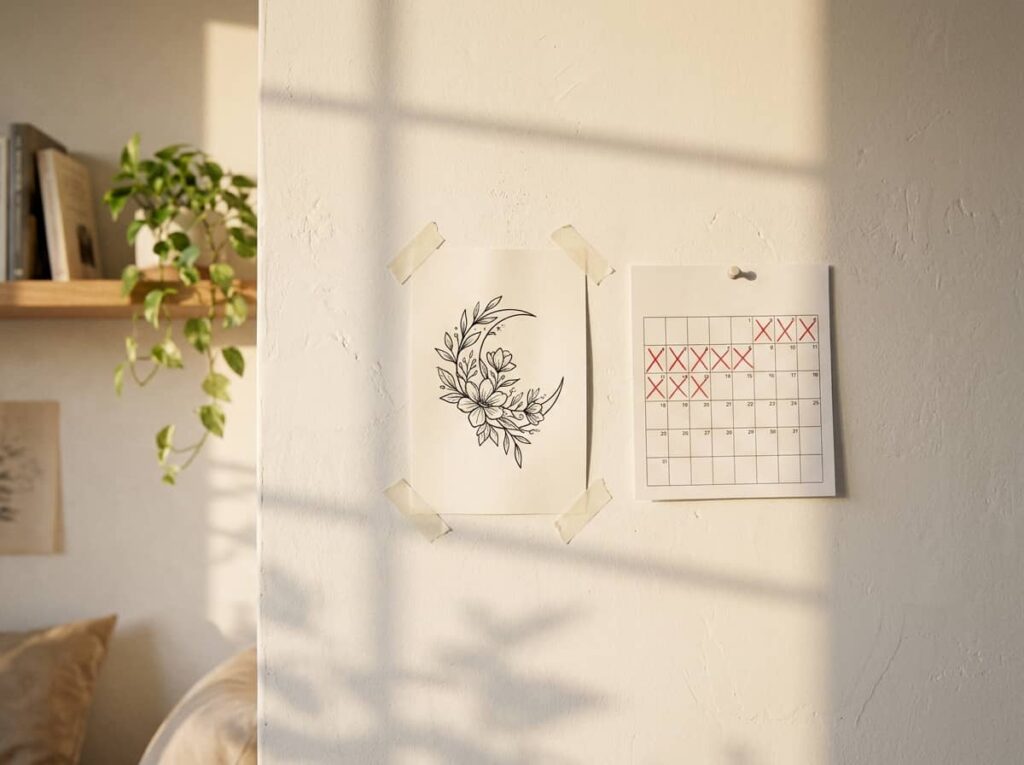
Pick a number, two weeks, a month, whatever feels right, and hold your final design through that stretch without touching it.
Print it out or screenshot it and look at it every few days. Notice if your reaction changes. A design that still feels right on day thirty is a very different thing than one that only felt right the night you finished sketching it. This step costs you nothing but time, and time is the one filter no amount of research can replace.
Set a waiting period, two to four weeks works well.
Look at the design every few days without editing it.
Book only once the reaction stays steady through the full wait.
14. Fill In Your One-Page Meaning Worksheet
This is the step that ties the other thirteen together into something you can actually screenshot and keep.
One page, five blanks: the feeling, the chapter, the one-sentence meaning, literal or abstract, and placement. Fill it out by hand once your shortlist is down to one design. It becomes your answer key for the consultation, and it’s the thing you’ll come back to years later when someone asks why you chose what you chose.
📋 My Meaning Worksheet
Conclusion
Choosing a meaningful tattoo isn’t about finding the perfect image on the first try. It’s about narrowing down, from a feeling to a chapter to one honest sentence, until the design left standing is one you could explain the same way in five years as you would today. That’s the real test, and it’s one no amount of scrolling can do for you.
Keep your one-page worksheet nearby through the consultation and the waiting period both. If the five blanks still feel true after a few weeks, you’ve found your answer.







Leave a Reply