Most wing tattoos go wrong for one simple reason. The wings are the wrong size for the spot they live on.
Wide angel wings squeezed onto a wrist turn into a gray blur. Tiny feather wings floating on a big back look lost. It is rarely the design that fails. It is the match between the wing and the body area.
So this list of wing tattoo ideas for women sorts every design by wing type, then shows it on a spot where it actually fits. You will find angel wings, feather wings, and butterfly wings, from a small mark on the ankle to a full spread across the back. Some are quiet enough to hide under a sleeve. Others are meant to be seen from across a room.
Read for the wing you like first. Then check the spot, the size, and the style that goes with it. Bring your favorites to your artist, and let them tell you what works on your skin.
Paste each code block below into a WordPress Custom HTML block.
1. Full Angel Wings Spread Across the Upper Back
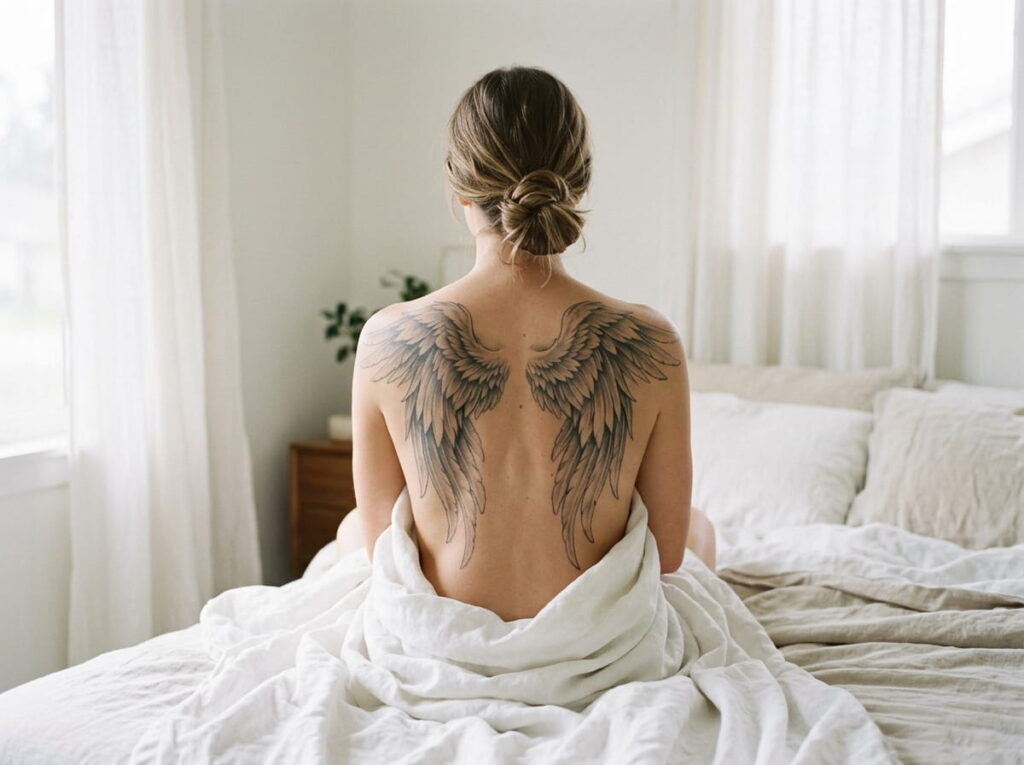
Start at the shoulder blades and let the wings grow outward.
A full set needs width, and the upper back is the one spot that gives it plenty. Angel wings look most natural when the feathers get longer toward the bottom edge, with short, soft ones near the spine. Leave a gap in the middle so the wings seem to open from your own back instead of sitting on top of it.
- Match the wingspan to your shoulder width
- Pick one angle, either open and raised or folded and resting
A piece this size takes more than one session, so plan for that.
2. Tiny Angel Wings Around a Date on the Wrist
Small wings turn to mush when every feather gets its own line.
On a wrist, think of the wings as two simple shapes with three or four feather strokes each. Put a date or a set of initials in the center, in thin type or a Roman numeral, so the wings frame it. Wrists get washed and sunned all day, so steady lines hold up better than hairlike ones.
Choose a date that will still matter to you in ten years.
💡 Quick Tip
Ask your artist to print the date in the exact font on the stencil. Wing shapes forgive small wobbles, but numbers do not.
3. One Angel Wing Sweeping Down the Shoulder Blade
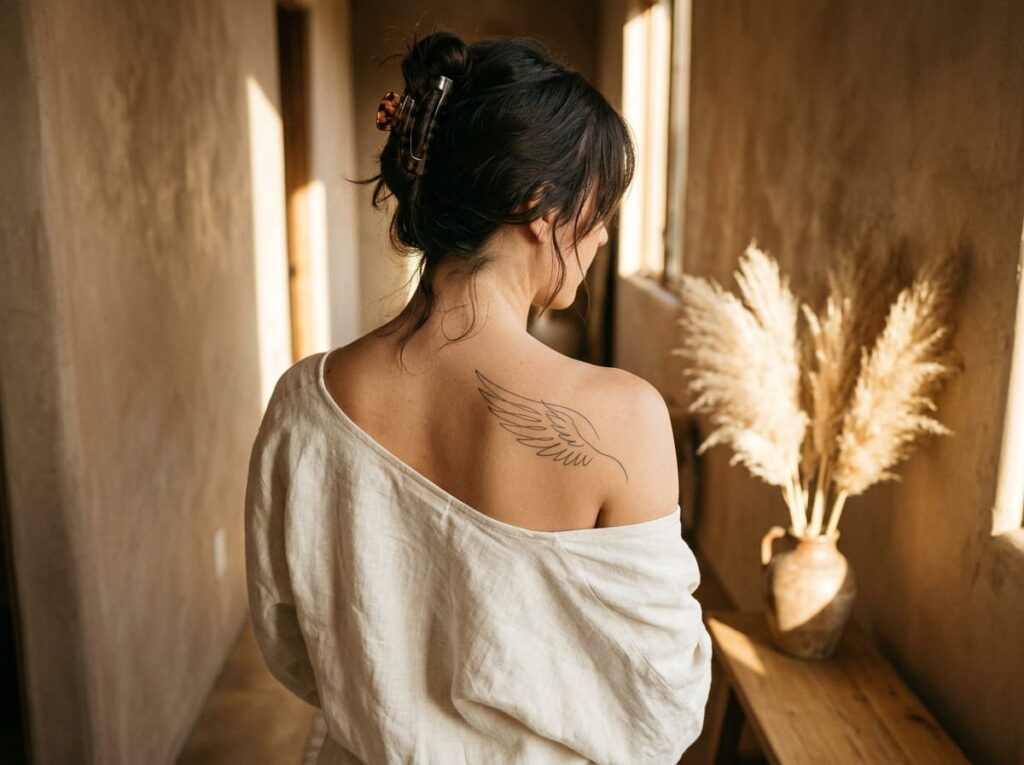
A single wing says as much as a pair and takes half the space.
Sweep it from the top of the shoulder blade down toward the spine, with the longest feathers pointing at the waist. Because it sits on one side, the wing leaves room for the rest of your back, and you can add a second wing or a flower later if you want to.
Choose a side before the stencil goes on, since a left wing and a right wing curve in opposite directions.
4. Fine Line Angel Wings Framing the Sternum
One rule for this spot: keep it symmetrical.
The sternum is the center line of your body, and any lean to one side shows right away. Draw a small pair of wings that fan out left and right from a tiny center point, like a dot, a small heart, or a short vertical line. Keep the wings narrow so they sit between the ribs. Many people find this area sensitive, since the skin is thin over the bone.
Stand straight in front of a mirror and mark the center line of your chest with a washable marker.
Ask your artist to mark both wing tips with dots and measure each side from the center.
Check the stencil while standing, sitting, and leaning forward before you approve it.
5. Feather Wings Drawn as a Row of Quills Along the Spine
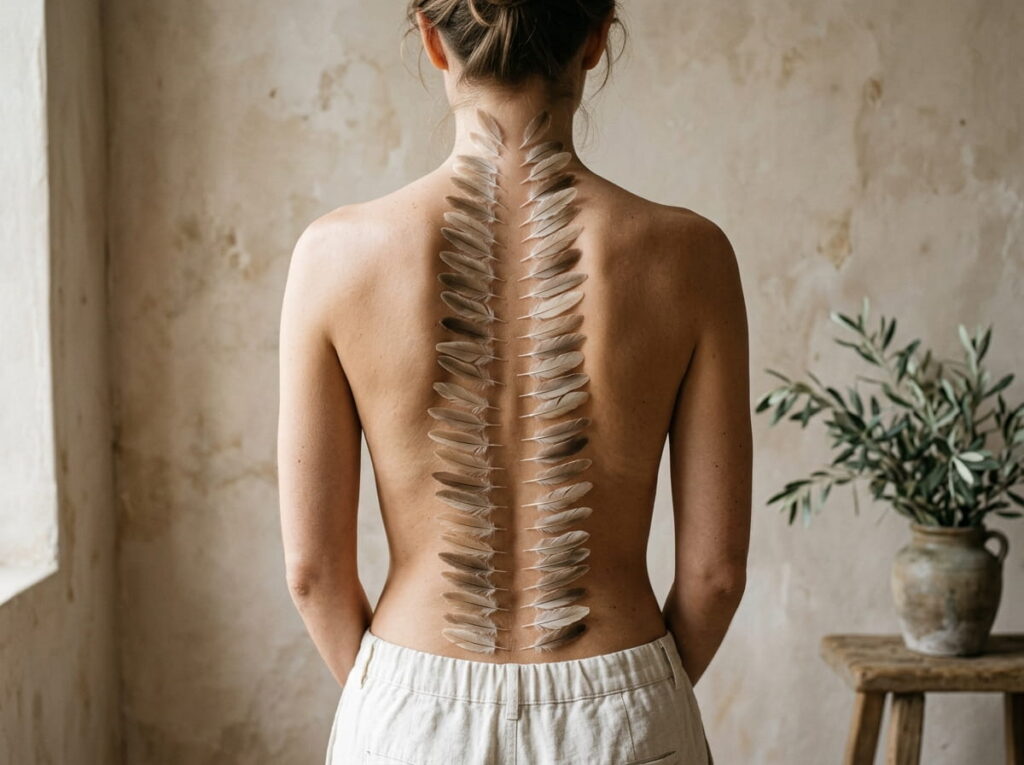
Wings do not need a body to read as wings.
Stack long quill feathers in a row down each side of the spine, short at the top and longer toward the bottom, and the eye fills in the rest. The shape stays light, and the spine acts as the center of the design.
- Space each quill so the lines do not touch
- Vary the lengths a little, so it looks like feathers and not a fence
It suits anyone who wants wings without the angel look.
Taper each quill to a soft point.
Add a few small barbs along the edges for movement.
Identical feathers repeated like a stamp.
Lines packed so close they can blur together as they heal.
6. A Single Feather With a Wing Tip Flick on the Ankle
Ankles take a beating from socks, shoes, and straps.
Keep the design to one feather with a small flick at the tip, like a wing catching air. Set it just above the ankle bone, on the side that rubs the least, and angle it slightly forward so it looks like it is moving. Make the center spine a bit thicker than the barbs so the shape holds together as it heals.
Loose socks and open shoes for the first few days will save you a lot of irritation.
What to bring to the appointment
7. White Dove Wings in Soft Shading on the Upper Arm
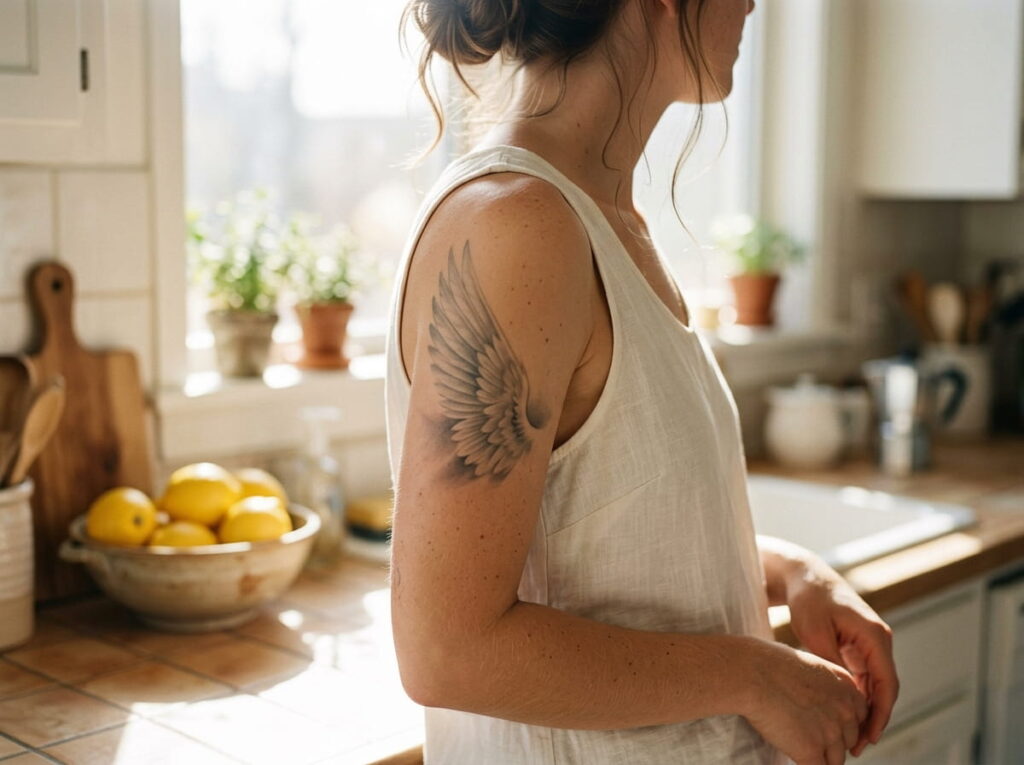
Look closely at a dove’s wing and you will notice the softness comes from shading, not outlines.
So skip the dark border. On the upper arm, build the wing with gentle gray gradients and let the feathers overlap in layers. The wings can flare toward the elbow, with the tips pointing slightly down, which gives a calm, resting look instead of a dramatic one.
- Ask for the darkest shading near the base of the wing
- Let the tips fade out into bare skin
Keep the arm relaxed when the stencil goes on, because a flexed muscle changes the shape.
In soft shading, your bare skin is the white. White ink can fade or look uneven, so ask your artist to leave skin untouched where the wing should look brightest.
8. Dark Raven Wings in Blackwork Across the Chest and Shoulders
Raven wings flip the usual wing tattoo on its head. They are heavy, glossy, and dark.
Across the collarbones and over the tops of the shoulders, the feathers can sweep outward like a cape. Ravens have thick, curved feather tips, so ask for sharp points and leave a few thin gaps of skin to suggest shine. The chest is a spot many people find tender, so shorter sessions can help.
It suits anyone who finds soft, pretty wings a little too sweet.
| Solid blackwork | Black and gray shading |
|---|---|
| Bold, flat black with crisp edges. | Soft gradients from gray to deep black. |
| Large solid areas may need a touch up. | Blends depend heavily on the artist’s skill. |
| Best for a graphic, modern look. | Best when you want detail in each feather. |
9. Watercolor Feather Wings Fading Into Color on the Calf
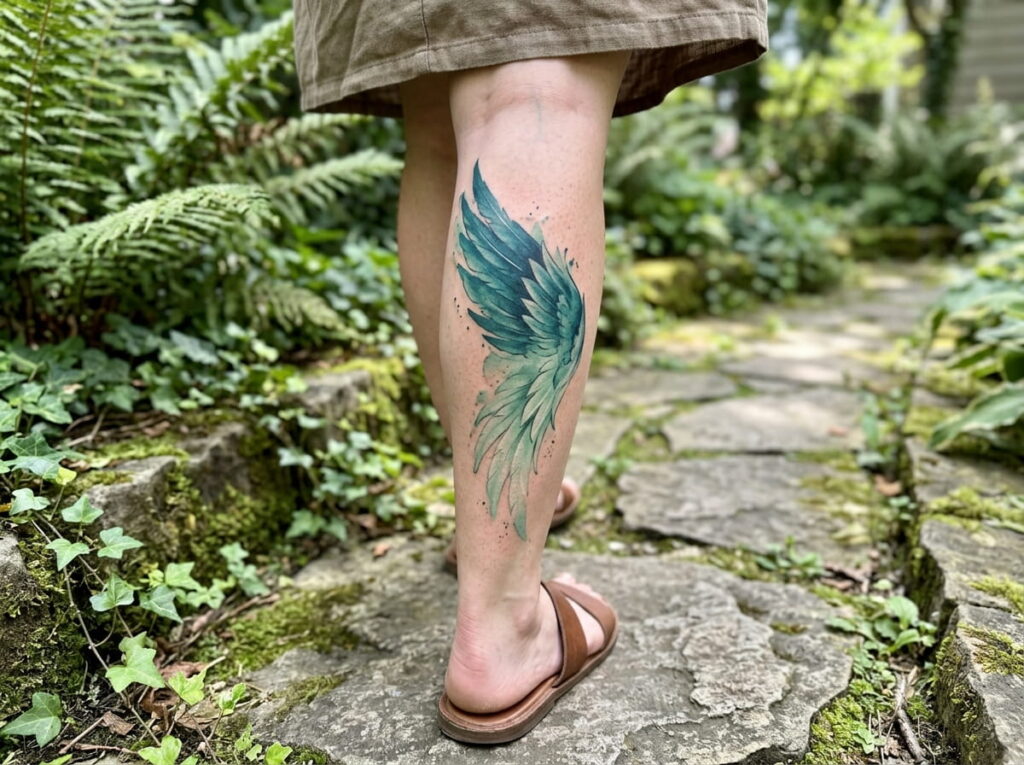
The usual mistake with watercolor wings is giving every feather its own color.
Choose one color family and let it shift as it runs down the leg, such as deep teal near the top and pale mint at the tips. The calf is long and vertical, so the wings can run from behind the knee toward the ankle. Keep a thin dark line on the longest feathers, so the shape survives as the color softens over time.
Bring a photo of the exact shades you want, since screens and skin never match exactly.
Wings in five unrelated colors that compete with each other and blur together.
One color family, deeper at the top and lighter at the tips, with a thin dark outline on the longest feathers.
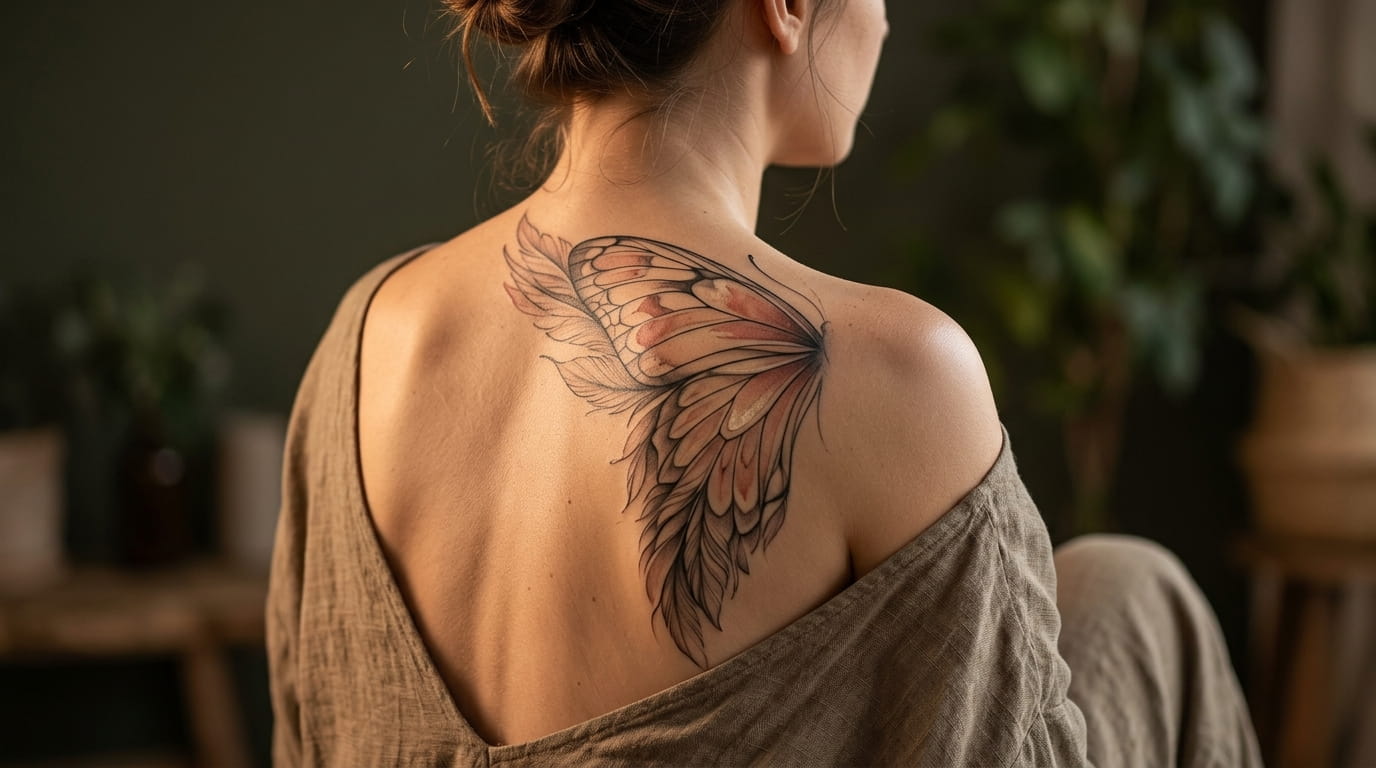
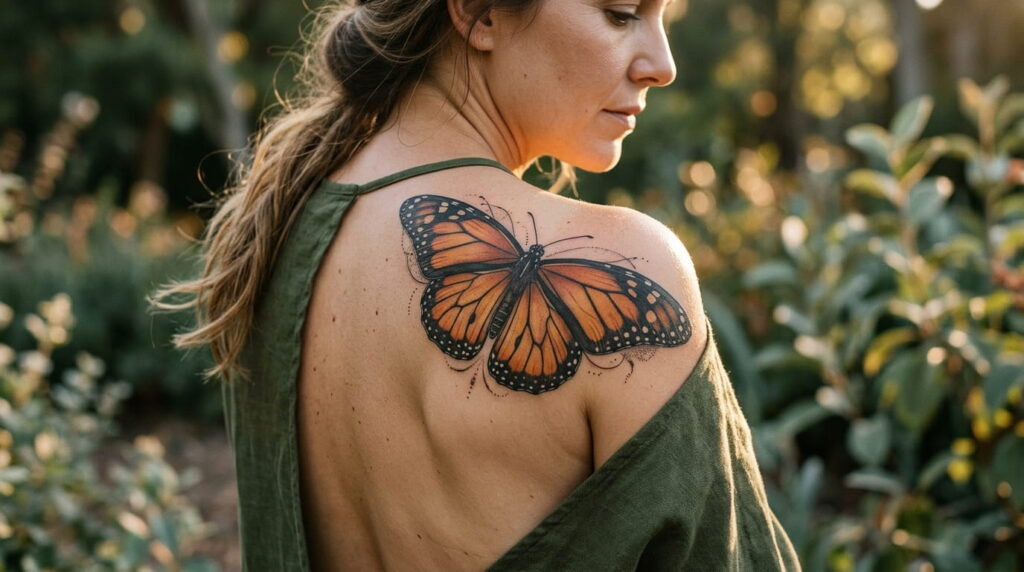
10. Monarch Wings With Fine Line Veins on the Shoulder
Start with the veins, then add the color.
Monarch wings are easy to spot because thin black lines divide the orange into small panels, and white dots run along the dark edges. On the shoulder, draw the veins so they curve with the round of the joint. Then fill the panels with orange, leaving a sliver of skin between the color and the black so the lines stay sharp. Place the wings open and angled slightly upward, as if the butterfly just landed.
⚠️ Watch Out
Shoulders get a lot of sun, and bright orange and yellow ink can fade sooner in it. Use sunscreen once the tattoo has fully healed, and ask your artist how touch ups are handled.
11. Mirrored Butterfly Wings Hugging the Neckline
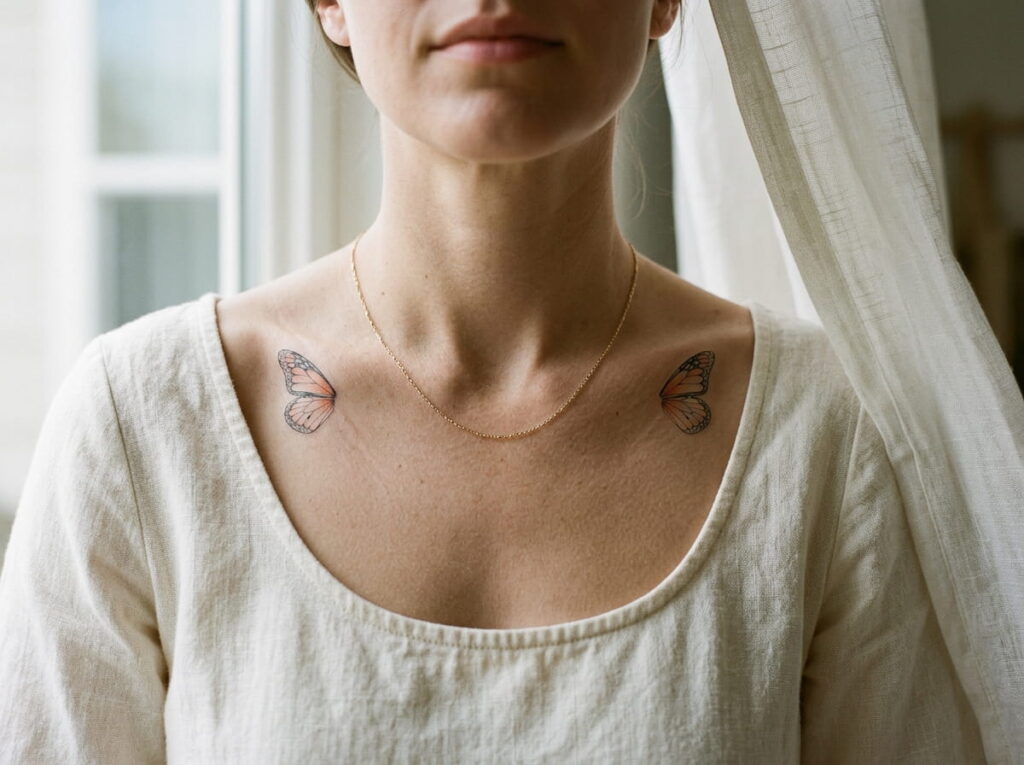
Look at a butterfly head on and the two wings mirror each other almost exactly.
At the neckline, that symmetry lets one small wing sit over each collarbone, with the tips pointing toward the shoulders. Keep them thin and close to the bone so they follow the neckline instead of crossing it. A scoop neck or a necklace will frame them, and a high collar will cover them completely.
Check the stencil with your usual necklaces on, since a pendant can land right on top of a wing.
12. Geometric Butterfly Wings Built From Triangles on the Hip
Triangles first, curves later.
Geometric wings come from straight lines. Split each wing into an upper and a lower triangle, then split those again into smaller panels. On the hip, the bone gives you a natural angled edge to line the top of the wing against. Shade every other panel, or leave some of them empty, so the design reads as a pattern and not one dark blob.
Hips shift as you move, so ask your artist whether slightly looser lines would suit this spot.
- ▸Line weight: even lines look clean, mixed weights look hand drawn
- ▸Panel count: fewer, larger panels age better than many tiny ones
- ▸Shading: solid fill, dotwork, or empty, chosen panel by panel
- ▸Alignment: how straight the center line sits against your hip bone
13. Butterfly Wings Breaking Into Small Birds Across the Back
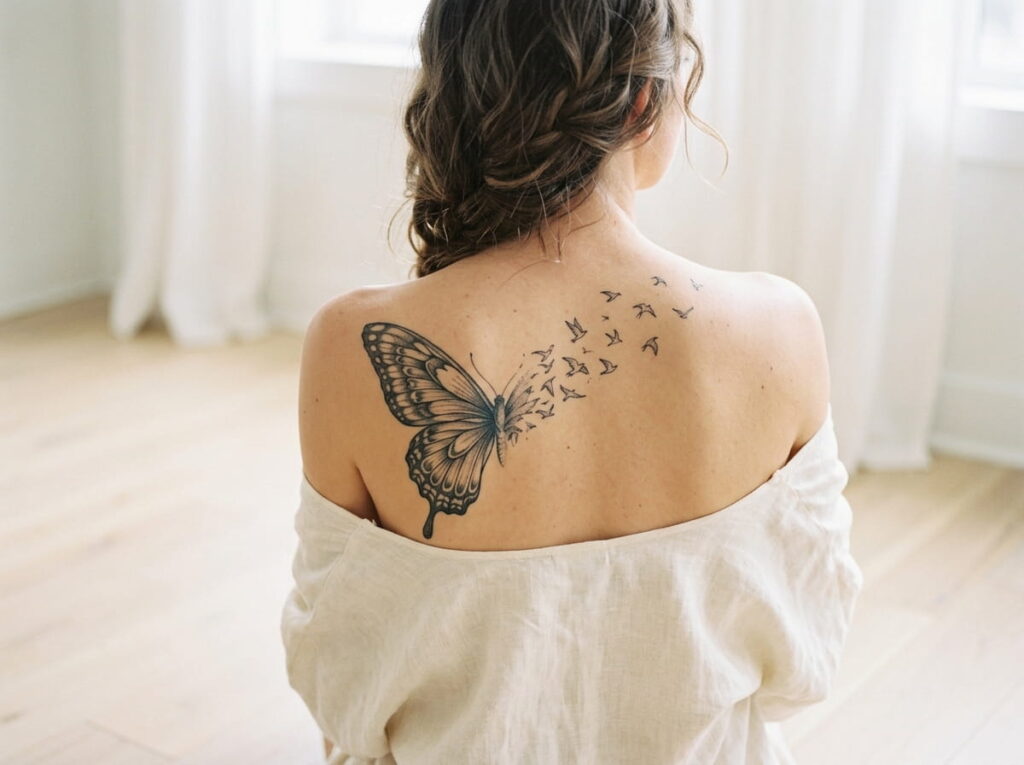
A tattoo with movement can tell a story without any words.
Start with one full butterfly wing at the shoulder blade. Then let its lower edge come apart into small birds that fly across the back, like pieces drifting off in the wind. Make the first few birds larger and the later ones smaller, so the flock seems to travel into the distance.
- Keep the wing as the darkest, most detailed part
- Let the birds get lighter and simpler as they leave it
It takes a wide, open canvas, and the upper back has plenty.
The wing. Largest, darkest, and most detailed, anchored at the shoulder blade.
A handful of birds, shrinking in size and fading in tone as they move away from the wing.
14. A Pair of Small Butterfly Wings at the Nape of the Neck
The common mistake at the nape is going too wide.
The skin narrows toward the hairline, and wings that stretch too far run into the sides of the neck. Keep the pair about two fingers wide, with the body in the middle as a short line or a single dot. Short hair shows it off, long hair hides it, and an updo makes it a small surprise.
If you plan to cut your hair soon, tell your artist before the stencil goes on.
Ask your artist before you book
Conclusion
The best wing tattoo ideas for women start with a simple match: the right wing for the right spot. Angel wings need room to spread. Feather wings can be one quill or a full row. Butterfly wings can sit small and symmetrical, or break apart into something wilder.
Pick the wing type that feels like you, then ask how it will look on your own body, in your own clothes, at your own size. A good artist will help you fine tune the rest.
Save this list for the next time you are narrowing down a design, and come back to it before you book.
The right wing for the right spot beats the biggest wing every time.
Leave a Reply