Lavender has a way of showing up right when you want quiet. It’s the plant people put by their pillow, hang in bunches above the stove, add to a cup of tea after a long day. That calm quality is exactly why lavender tattoo ideas have become a favorite for anyone who wants body art that feels gentle instead of loud.
A lot of botanical tattoos lean busy, packed with detail that competes for attention. Lavender does the opposite. A single stem, a loose cluster of buds, a soft wash of violet ink: it reads as calm from a few feet away and holds up close too. That makes it a good fit for a first tattoo, a quiet addition to a collection, or a small piece tucked somewhere personal.
The ideas below cover different placements, line styles, and pairings, from a tiny sprig behind the ear to a full wreath around the ankle. Some lean minimal, some lean fuller, but all of them keep that same soft, settled feeling lavender is known for.
- 1. A Single Lavender Sprig Behind the Ear
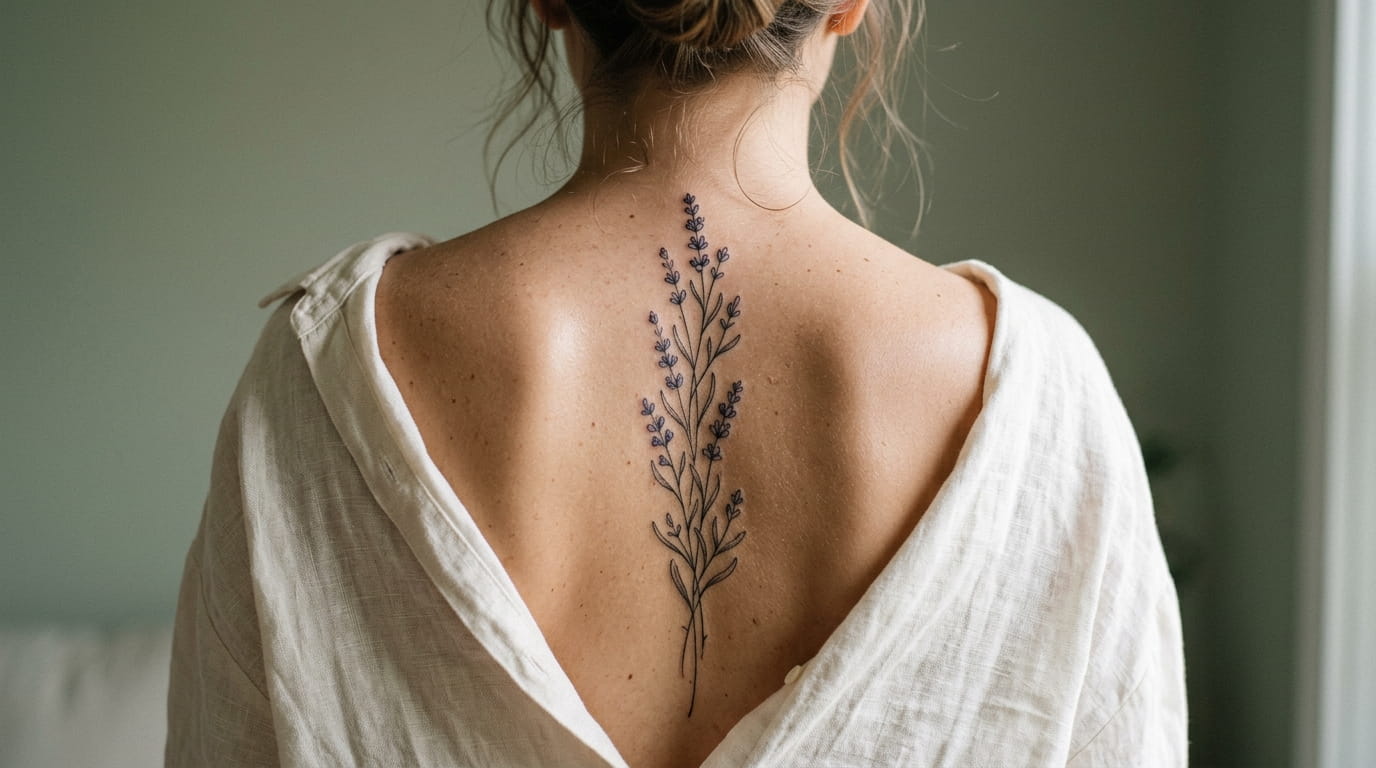
- 2. A Trailing Lavender Stem Down the Spine
- 3. A Cluster of Three Lavender Stalks on the Ribcage
- 4. Fine Line Lavender Wrapped Around the Wrist
- 5. A Lavender Sprig Tucked Behind a Crescent Moon
- 6. Watercolor Lavender Bouquet on the Shoulder
- 7. Minimalist Lavender Stem on the Inner Forearm
- 8. A Lavender Branch Wrapped Around the Finger
- 9. Dotwork Lavender Silhouette on the Ankle
- 10. A Lavender Sprig Paired with a Tiny Bee
- 11. A Lavender Field Mini Landscape on the Forearm
- 12. A Lavender Wreath Encircling the Ankle
- 13. Lavender Stem with a Butterfly Accent on the Collarbone
1. A Single Lavender Sprig Behind the Ear
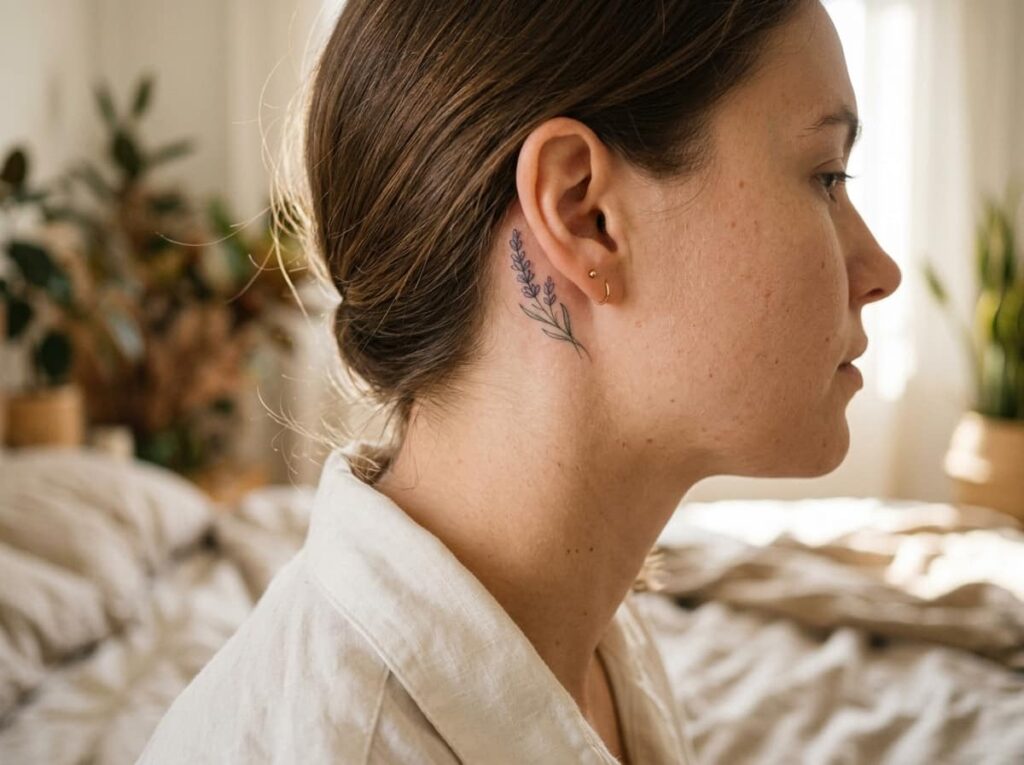
Small placements call for small designs, and this is about as quiet as lavender tattoos get. One sprig, maybe two or three stems, sitting just behind the ear where hair covers it on busier days.
It works well as a first tattoo:
- Skin here heals fast, usually within a week or two
- The design itself takes under an hour
- Fine linework keeps it from blurring as it ages
Ask your artist for single needle work and no more than three stems so it stays delicate instead of crowded.
💡 Quick Tip
Behind-the-ear skin is thin, so book a touch-up around the six-week mark if any lines look patchy after healing.
2. A Trailing Lavender Stem Down the Spine
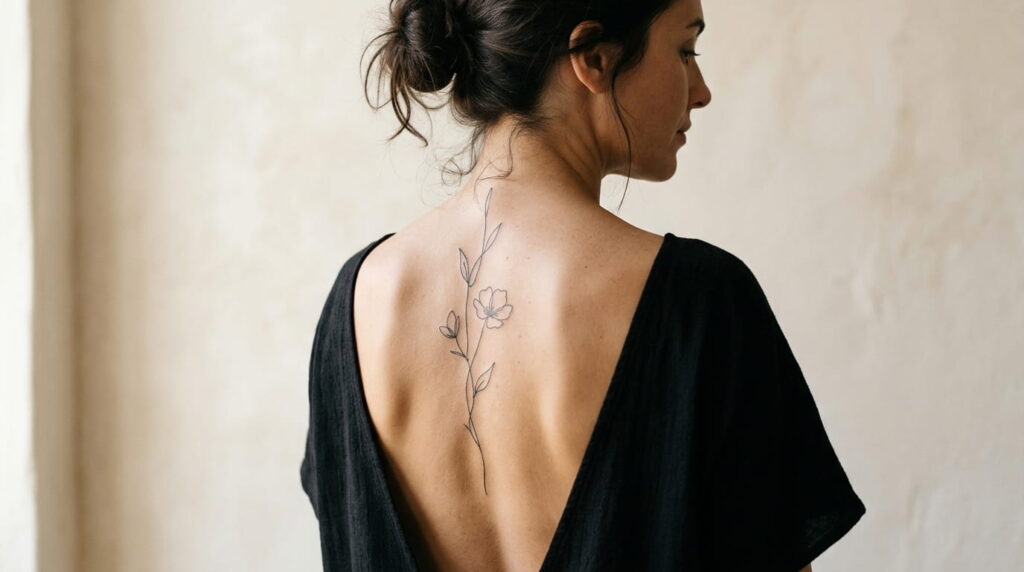
A single stem running the length of the spine reads almost like a vine, each bud spaced slightly apart as it travels down. The top can start between the shoulder blades or sit lower, near the mid back, depending on how much you want showing above a backless top.
This placement takes patience. The spine isn’t the easiest spot to sit for.
Worth knowing before you book:
- Most artists split it into two shorter sessions
- Each sitting runs 45 minutes to an hour
- A few days between sessions lets the skin settle
3. A Cluster of Three Lavender Stalks on the Ribcage
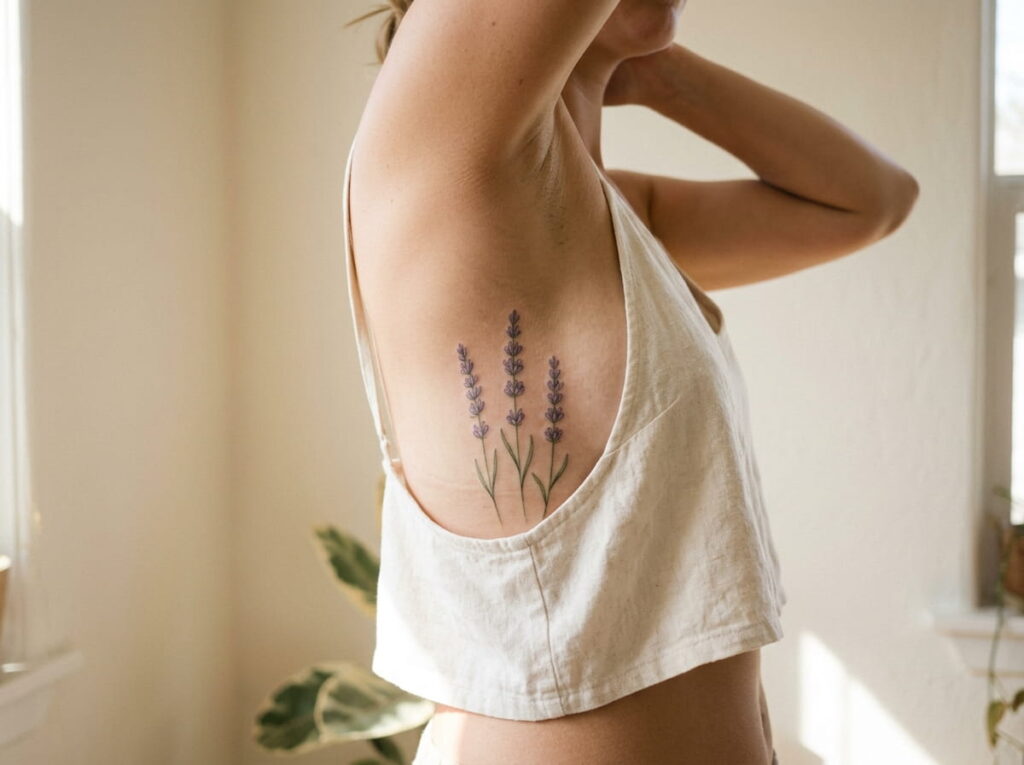
Ribcage space is generous, and that’s exactly the trap. Three stalks, angled slightly apart with a few loose buds between them, usually fills the space well without tipping into a dense bouquet.
Side ribs swell more than most placements, and the skin moves with every breath, so healing takes real patience. Most people find the first three days the hardest, then it eases quickly after that.
A looser top for the first week. That one change does more for this spot than any ointment.
A consultation where the artist sizes the stalks to fit your ribcage curve.
A stencil placed and checked while you’re standing, since the fit shifts with posture.
The session itself, often finished in one sitting for a design this size.
4. Fine Line Lavender Wrapped Around the Wrist
People ask for a full wrap and end up with lines so thin they fade within a year. Wrist skin sees constant movement and friction, from watches to sleeves to washing hands a dozen times a day, so the linework needs a little more weight than it would somewhere protected like the ribcage.
A half wrap, stopping before the inner wrist, tends to age better than a complete circle. It still reads as a soft lavender bracelet without the thinnest lines taking the brunt of daily wear.
This one works best for people who already live in long sleeves half the year, since healing skin stays shielded without much extra effort.
Wear loose sleeves or push cuffs up for the first week.
Take your watch off until the skin fully heals.
Soaking wrists in dishwater or long baths too soon.
Tight bracelets layered over fresh linework.
5. A Lavender Sprig Tucked Behind a Crescent Moon
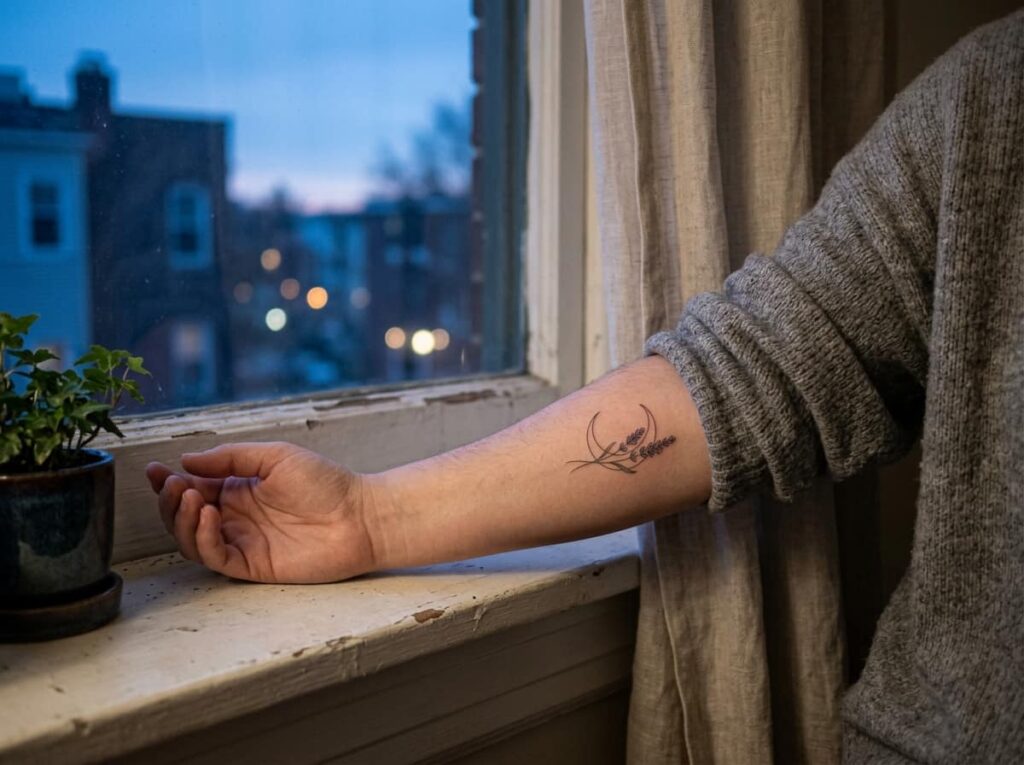
Pairing lavender with a crescent moon gives the design a little more meaning without adding visual weight. The moon sits behind or beside the sprig, usually sketched as a thin outline so it doesn’t compete with the botanical linework.
This combination works almost anywhere a single sprig would: behind the ear, on the forearm, along the collarbone. The trick is scale. A moon much larger than the lavender pulls focus away from the flowers, so most artists keep it close to the same size or slightly smaller.
Done well, the pairing feels symbolic without turning into a tattoo you have to explain every time someone asks about it.
Ask your artist about
6. Watercolor Lavender Bouquet on the Shoulder
A cardigan slipping off one shoulder, or a swimsuit strap pushed aside, is usually the first time this design gets noticed. Watercolor shoulder work gives lavender its softest look yet, blending purples and blues without hard outlines holding everything in place.
Shoulders also forgive a slightly bigger design better than most spots, since the skin stays flat and doesn’t shift the way a ribcage or wrist does.
Ask your artist how the color will look in three years, not just on day one. Watercolor softens naturally, and knowing that ahead of time saves disappointment later.
7. Minimalist Lavender Stem on the Inner Forearm
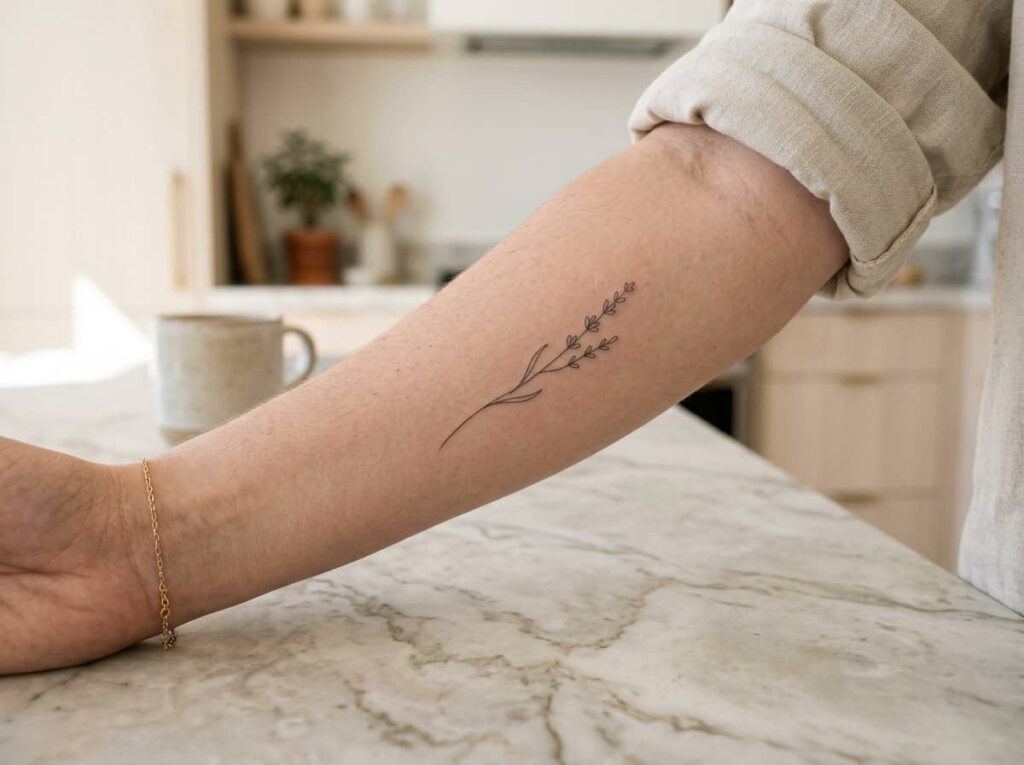
Not every lavender tattoo needs full color or layered buds. A single stem, drawn in one continuous line, trades detail for restraint and often ages better simply because there’s less linework to blur.
Minimalist pieces also cost less and take less time, which matters if this is a first tattoo or an add-on to an already busy forearm.
Where it falls short: texture. There’s no shading to hint at petal depth, so some people find a bare stem feels unfinished next to bolder pieces nearby.
| Minimalist Stem | Detailed Botanical |
|---|---|
| Faster session, lower cost | Longer session, higher cost |
| Ages cleanly, little blur risk | More shading can soften with age |
| Can read as plain up close | Reads as a full piece up close |
8. A Lavender Branch Wrapped Around the Finger
Finger tattoos follow one rule above almost every other: expect a touch-up. Skin here regenerates faster than anywhere else on the body, so even careful linework tends to fade or blur within the first year.
A lavender branch wrapping from the base to the first knuckle keeps the design small enough that a touch-up stays quick and affordable.
Fine lines fade fastest here, so ask your artist about slightly thicker strokes if you want the design to hold longer between sessions.
Finger tattoos almost always need a touch-up within the first year. Budget for it from the start.
9. Dotwork Lavender Silhouette on the Ankle
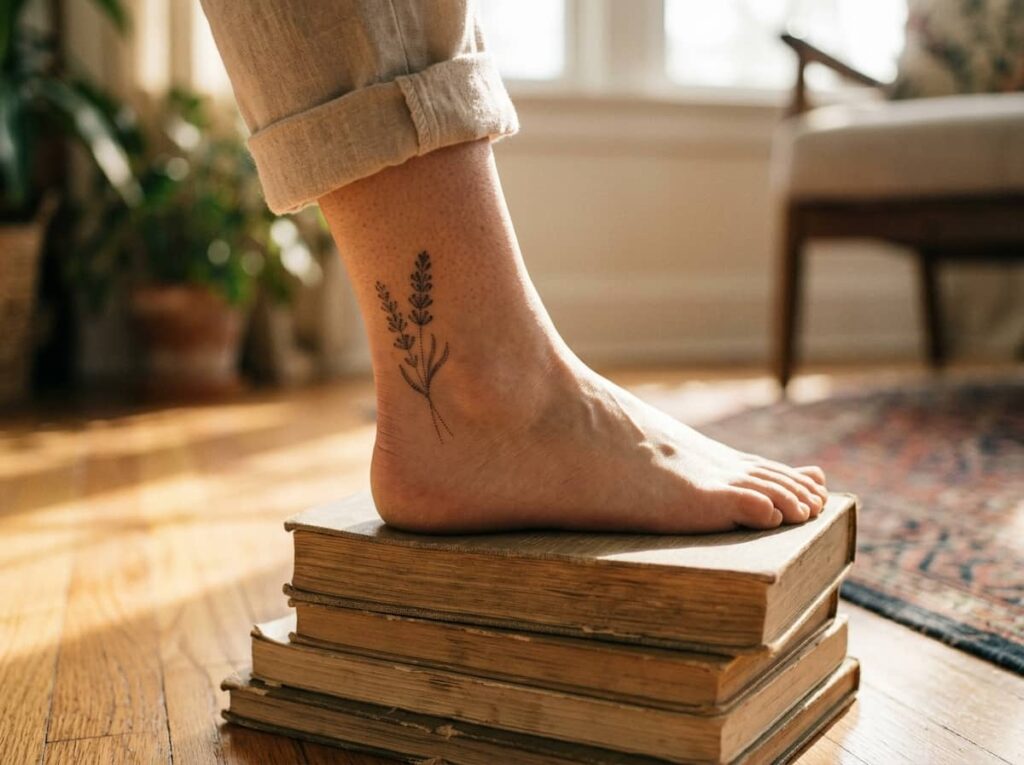
Build the silhouette with dots instead of solid lines and the lavender stem takes on a soft, shadowed look, like it’s caught in low light. Dotwork takes longer in the chair than linework of the same size, since every dot is placed one at a time.
Pick an artist who shows dotwork specifically in their portfolio, not just linework with shading layered on top. Even spacing and steady pressure is its own skill, separate from drawing a clean line.
💡 Quick Tip
Ask to see healed dotwork photos, not just fresh ones. Dots hold their shape differently than lines once the skin settles.
10. A Lavender Sprig Paired with a Tiny Bee
Lavender draws bees in real gardens, so pairing the two in ink isn’t just decorative, it mirrors something that actually happens outdoors. The bee usually sits smaller than the lavender, angled like it just landed on a bud.
Healed, the two elements settle at slightly different rates. Fine bee wings often soften faster than the thicker lavender stem lines, which is normal and doesn’t mean anything went wrong.
Choose a bee pose with simple wings rather than heavy detail, since tiny linework fades fastest in color fields.
Crisp, dark lines with sharp edges on both the lavender and the bee’s wings.
Softer wing lines, steady lavender stem, a slightly muted overall tone.
11. A Lavender Field Mini Landscape on the Forearm
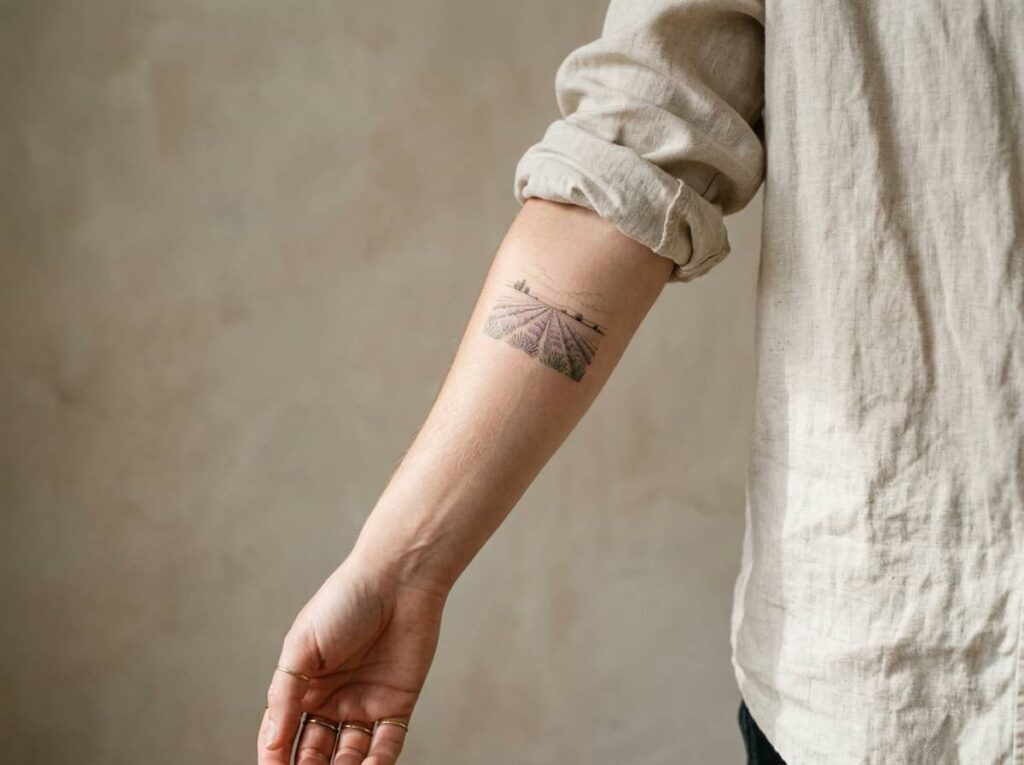
Instead of a single plant, this design pulls back to show rows of lavender stretching toward a low horizon line, like a tiny postcard inked on skin. It’s one of the more detailed ideas on this list, closer to a small scene than a single botanical.
Getting the depth right takes planning:
- The artist sketches a simple horizon line first, keeping it low so the lavender rows have room
- Rows closer to the viewer get slightly bolder lines, rows further back get thinner ones
- A faint sun or soft sky shading gets added last, only if there’s room without crowding the field
This one reads best at a slightly larger size, since shrinking a landscape too far turns the rows into a blur rather than distinct lines.
Sketch a low horizon line so the lavender rows have room to stretch.
Vary line weight between front and back rows to fake depth without shading.
Add a faint sun or sky shading only if the size allows, so the field stays the focus.
12. A Lavender Wreath Encircling the Ankle
A wreath asks for more commitment than a single sprig. Stems alternate direction around the ankle bone, meeting at the back or front depending on how your artist plans the join, which is usually the trickiest part of the whole design.
Ankle skin sits close to bone with little cushion, so this placement tends to rank higher on the pain scale than people expect going in.
13. Lavender Stem with a Butterfly Accent on the Collarbone
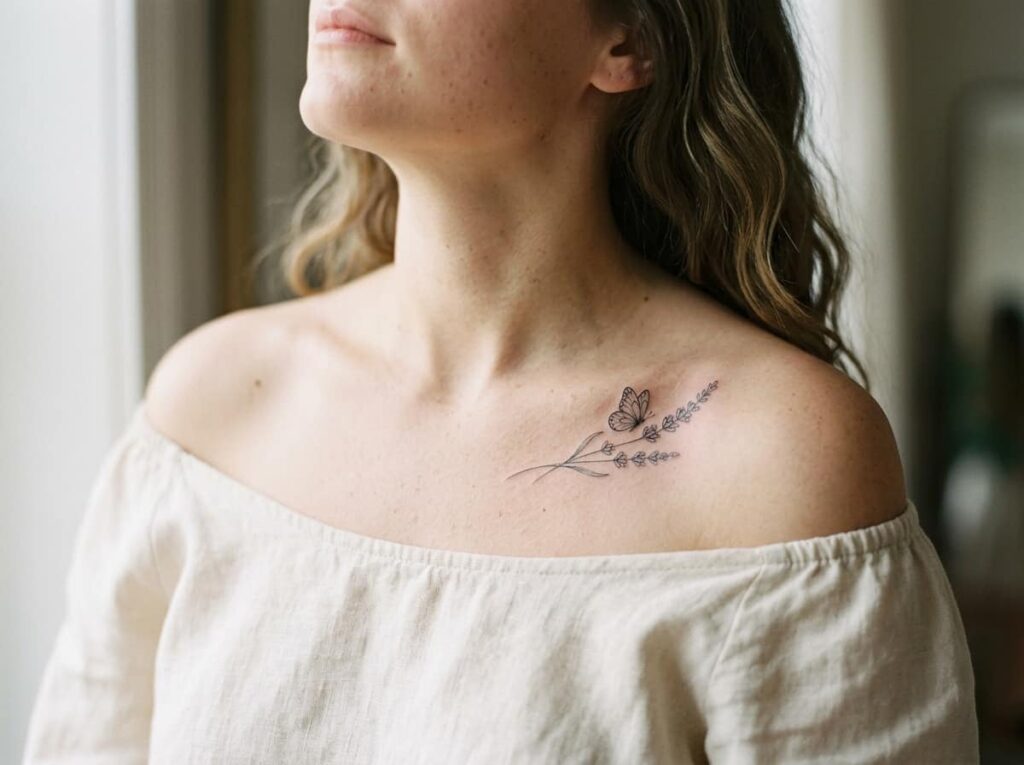
The collarbone’s narrow, curved shape favors a single stem over anything bushier, with a small butterfly resting near the top as if it just landed. Keeping the butterfly’s wings simple, outline only or lightly shaded, stops it from pulling focus away from the lavender itself.
Bring these to your consultation so the sizing fits the curve correctly:
- A clear photo of the collarbone area you want covered
- Reference images for both the lavender angle and the butterfly pose
- Any preference on which side the butterfly faces
Bring to your consultation
Conclusion
Lavender earns its place in tattoo work the same way it earns its place in a garden or on a windowsill: it doesn’t shout, it just settles in and feels right. Whether you go with a single sprig behind the ear or a full wreath around the ankle, these lavender tattoo ideas all share that same unhurried, soft quality that makes them easy to live with for years.
Placement matters more than people expect going in, and healing takes patience no matter how small the design looks on paper. Talk through sizing and line weight with your artist before anything gets inked.
Save this list for the next time you’re planning a tattoo that should feel calm, not loud.
Before you book
Leave a Reply