Most tattoo regret does not come from the needle. It comes from a fast decision on a design that looked great on a phone screen and wrong on an actual body.
If you have been saving small tattoo ideas for women for months and still have not booked, that hesitation is useful. It means you care about where the ink lands and how it will look in ten years, not just next week.
Small tattoos are harder than they look. Fine details can look different as years pass, some spots get more sun and friction than others, and a design that feels right at 25 may not feel right at 40. A few simple choices help with most of this: simple shapes, breathing room between lines, and a spot you enjoy looking at.
Nobody can promise you will never regret a tattoo. What this guide can do is help you lower the odds.
About This Guide
This guide combines general tattoo design principles with health guidance from the American Academy of Dermatology (AAD) and the Mayo Clinic. The design suggestions are editorial recommendations, and every tattoo artist works differently, so treat them as a starting point for your consultation. Nothing here is medical advice. Sources are linked at the end.
Five Facts to Know Before You Book
Healing takes about two weeks. The Mayo Clinic says most tattoos take about two weeks to heal, and your artist will give you aftercare instructions for your specific design and spot (Mayo Clinic). If it does not seem to be healing as expected, see a doctor.
Check the studio’s hygiene. The Mayo Clinic advises making sure the artist washes their hands, wears a fresh pair of disposable gloves for each tattoo and uses sanitary equipment (Mayo Clinic).
Sun can fade tattoo ink. The AAD says ultraviolet light can fade some tattoo inks. For tattooed skin that is exposed to the sun, it recommends a broad-spectrum, water-resistant sunscreen of SPF 30 or higher, applied 15 minutes before going outside and reapplied at least every two hours. It also says tanning beds and sunlamps can fade ink (AAD).
Moles and skin changes matter. The AAD suggests choosing skin that is free of moles, because a tattoo can make the earliest signs of skin cancer harder to see. It also notes that skin can react to tattoo ink right after getting a tattoo or years later, and recommends seeing a board-certified dermatologist if tattooed skin changes in any way (AAD).
Pain depends on the person and the spot. There is no clinical pain chart to rely on. One informal survey of tattoo artists and enthusiasts, run by the tattoo removal company Removery, found that bonier areas tended to be rated as more painful, with the ankles and shins ranked highest and the back of the knees described as highly sensitive (Removery). Treat this as a rough guide, not a rule.
- About This Guide
- Five Facts to Know Before You Book
- 1. A Single Fine Line Wildflower Stem on the Inner Forearm
- 2. A Tiny Crescent Moon Behind the Ear
- 3. Your Initials in Your Own Handwriting on the Inner Wrist
- 4. A Small Birth Flower Along the Collarbone
- 5. A Minimalist Wave Line Around the Ankle
- 6. A Tiny Butterfly on the Back of the Shoulder
- 7. A Three Dot Constellation Behind the Knee
- 8. A Matching Mini Symbol to Share With a Sister or Friend
- 9. A Tiny Heart Outline Hidden on the Inner Bicep
- 10. A Little Sun Symbol at the Base of the Neck
- 11. A Small Paw Print or Pet Silhouette Just Above the Elbow
- 12. A Slim Olive Branch Along the Side of the Wrist
1. A Single Fine Line Wildflower Stem on the Inner Forearm
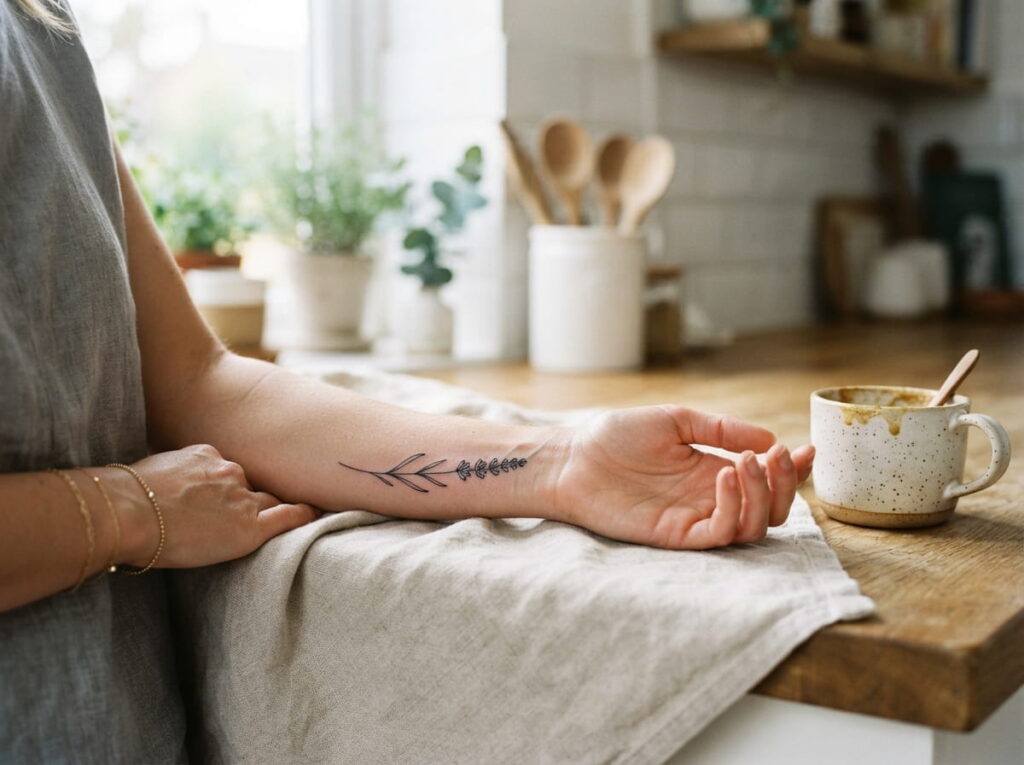
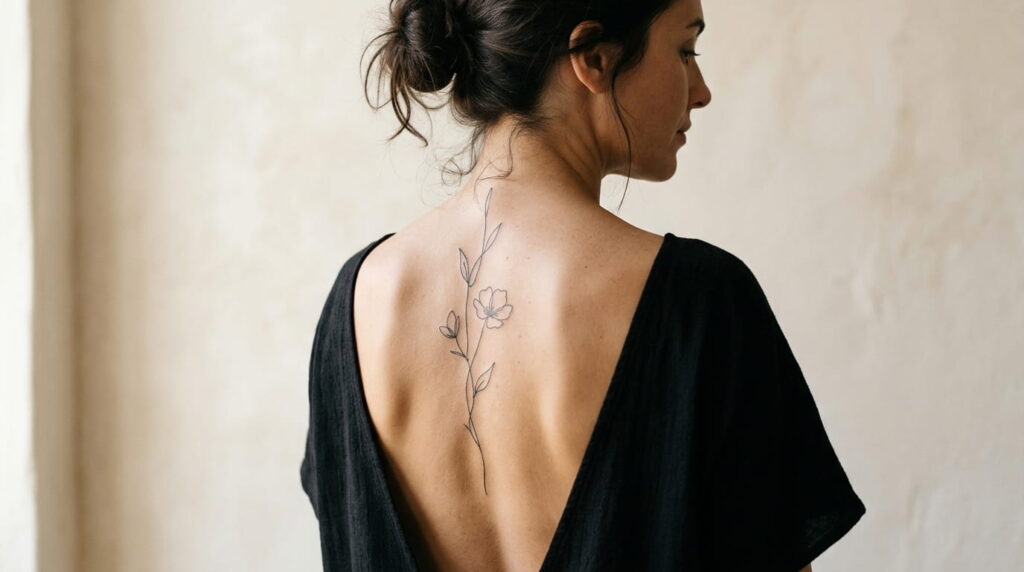
A single stem takes up very little space but still reads as a complete design.
Pick one flower with a clear silhouette, such as lavender, a daisy or a poppy, and let the stem follow the natural line of your arm. The inner forearm is a fairly flat, steady area, which gives an artist a clear surface to work on. It is also easy to cover with a sleeve at work and show on weekends.
Imagine this: two people bring the same wildflower to an artist. One wants twelve petals and three leaves. The other wants five petals and one leaf. Both look good on day one, but the busier version leaves far less room if the lines soften over time.
- Placement note: the forearm gets sun, so see the sun guidance above.
- Ask your artist: “Can you keep the petals few and open, and use a line weight that will hold up as it ages?”
2. A Tiny Crescent Moon Behind the Ear
This spot is chosen for how it looks, and it is worth thinking about how it works with your hair.
The skin behind the ear is thin and curved, so a design with fine inner details can look uneven. A crescent works because it is one clean curve with nothing inside it to blur. Keep it small enough to sit in the hollow, and ask the artist to follow the slope of your ear rather than a straight line.
Hair will cover it some days and frame it on others, which is part of the charm.
Try it first: before you book, draw the crescent with a skin-safe pen or use a temporary tattoo. Wear it for a few days with your hair up and down. If you still like it afterwards, that is a good sign.
Ask your artist: “Please stencil it with my hair up so we can see how it sits.”
3. Your Initials in Your Own Handwriting on the Inner Wrist
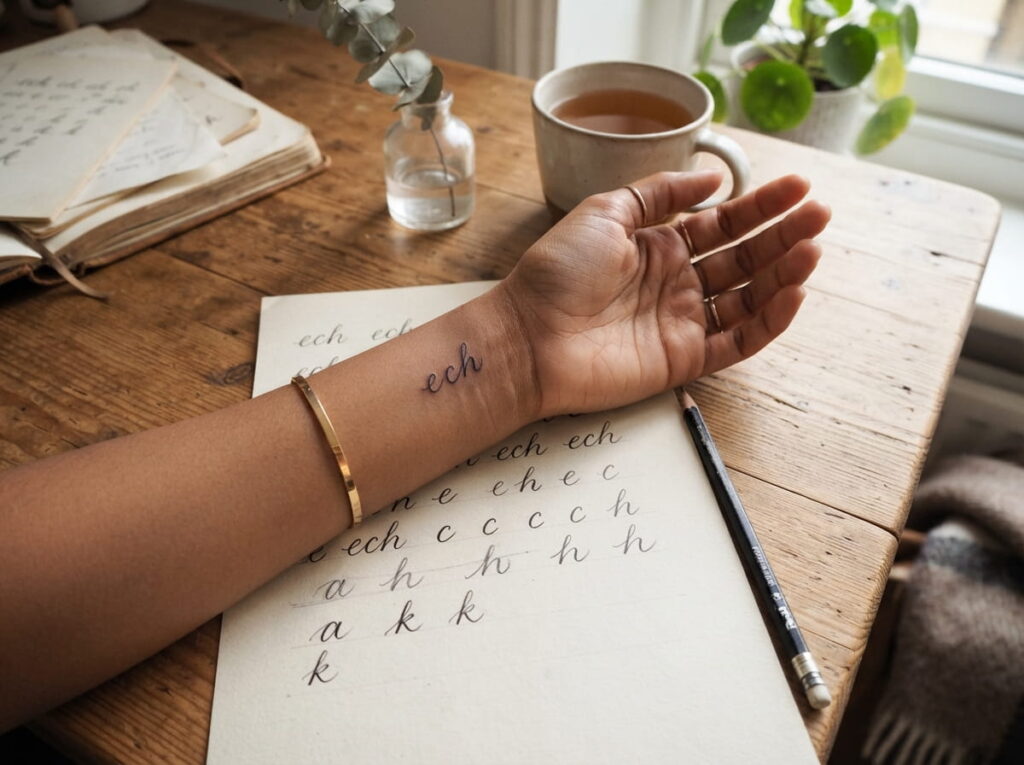
One rule saves most lettering tattoos: keep it to three letters or fewer.
Initials look best when they come from real handwriting, yours or someone you love. Write them ten times on paper, circle the one that feels most natural, and give that to your artist. A typed font can look stiff on skin, while handwriting has small quirks that make it personal.
The inner wrist bends all day, so give each letter room. Crowded letters are more likely to run together as lines soften. Bring the paper sample, not a screenshot.
Do: use one clean script with open loops, and bring a handwriting sample on paper.
Skip: tight cursive loops that can close up, and adding a date, a heart and a symbol on top.
4. A Small Birth Flower Along the Collarbone
Fine line and dotwork are both popular for birth flowers, and they create different looks.
| Fine line | Dotwork | |
|---|---|---|
| Look | Crisp, clean outlines | Soft, textured shading built from dots |
| Suits | Petals with clear edges | Rounded, gentle shapes |
| Worth asking | To see healed examples of the artist’s fine lines | To see healed examples of the artist’s dotwork |
Whichever you choose, place the flower so it follows the bone, and keep it big enough that every petal has a visible gap. Bra and bag straps can rub the collarbone area, so ask your artist what to wear while it heals.
- Ask your artist: “Which style do you do best, and can I see healed photos?”
5. A Minimalist Wave Line Around the Ankle
A single wave line sits just above the ankle bone and wraps part of the way around.
Keep it to two or three gentle peaks. Busy, tight waves can turn into a squiggle if the lines soften, while a plain curve stays readable. Shoes and socks rub the ankle, so plan the session for a stretch when you can wear loose footwear.
This is also a bony area. In the informal Removery survey mentioned above, ankles and shins were ranked as the most painful spots, so ask your artist what to expect and whether they can keep the line off the bone itself (Removery).
Ask your artist: “What footwear should I plan for during healing?”
Placement: above the bone, not on it
Line: one steady weight
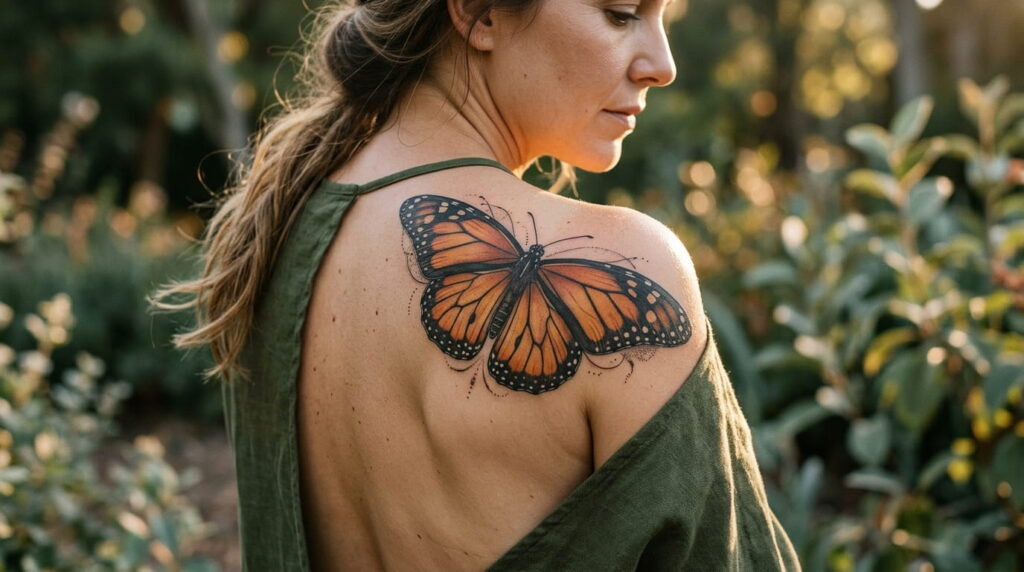
6. A Tiny Butterfly on the Back of the Shoulder
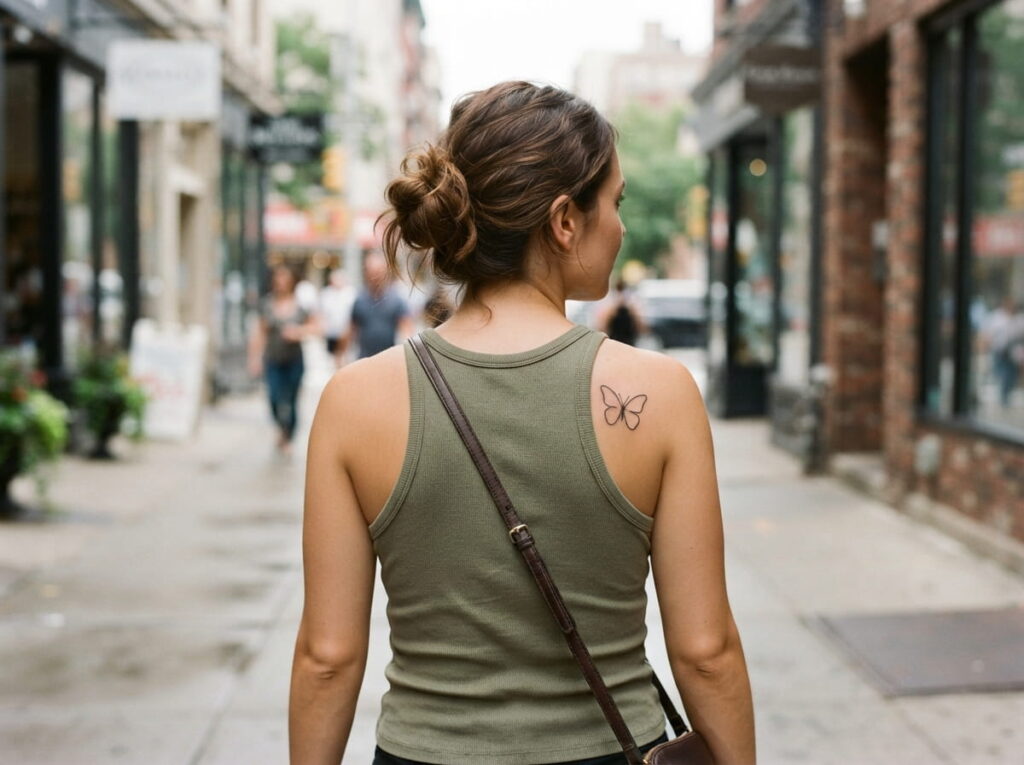
You cannot see your own back, and that is the whole problem with shoulder tattoos.
A small butterfly sits well on the shoulder blade, away from the spine, where the skin is relatively flat. Choose a simple silhouette with two wings and a slim body. Fussy wing patterns leave little space between lines.
Because you will rarely see it straight on, test the size and angle first. This takes about a week and costs almost nothing:
- Cut a paper butterfly to the exact size you have in mind and tape it to your shoulder blade with skin-safe tape.
- Take photos in a mirror and ask a friend for one from normal standing distance. Check it with a tank top and with a bag strap on.
- Live with it for a few days, then show the photos to your artist so they can stencil it and adjust the tilt.
Ask your artist: “Can we check the tilt with a stencil before you start?”
Placement note: shoulders catch a lot of sun in summer, so plan for sun protection.
7. A Three Dot Constellation Behind the Knee
Sit down and look at the back of your knee. The skin folds every time you bend, so any design here has to be forgiving.
Three dots in a loose triangle fit that rule. Make each dot about the size of a pencil tip and leave generous gaps, since dots placed close together are more likely to merge.
| Before | After |
|---|---|
| A star map with eight or nine tiny dots packed close together. Sharp on paper, but crowded on skin that folds. | Three dots with wide gaps. Each one stays clear and the shape still reads as a constellation. |
The Removery survey described the back of the knees as highly sensitive, and a joint that bends can be awkward to heal, so ask your artist how to care for it (Removery). It suits anyone who wants something private.
- Ask your artist: “How should I move and sit while this heals?”
8. A Matching Mini Symbol to Share With a Sister or Friend
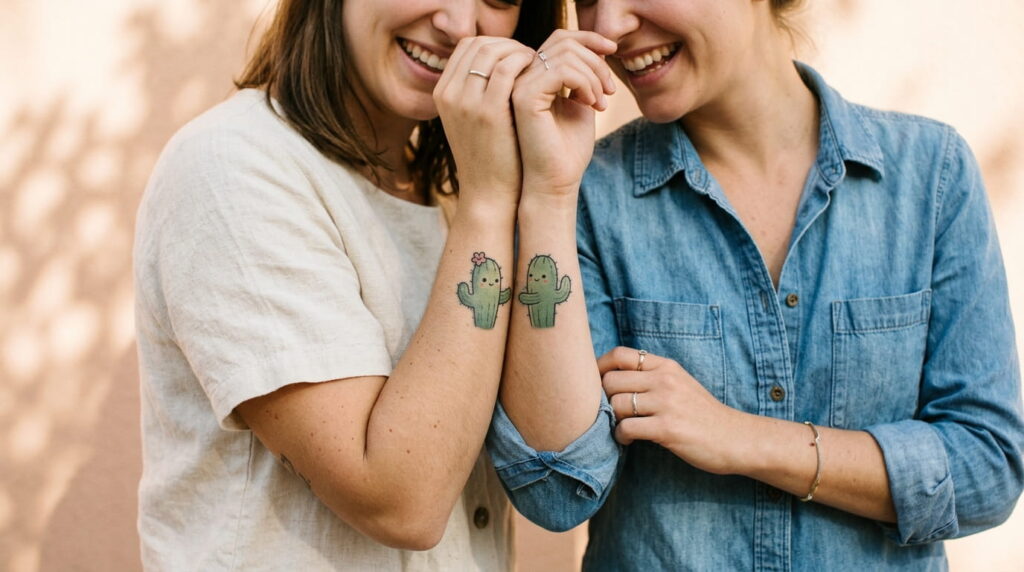
Agree on three things before you book: the symbol, the spot and the size.
Matching tattoos go wrong when only one person is fully sure. Choose something with a meaning you both understand, like a tiny wave, a small star or a shared initial. Pick placements that suit both of your lives, since a job that shows wrists may not suit a friend’s plans.
Imagine this: two friends choose a tiny wave for the inner wrist. One works in a relaxed office. The other works somewhere that requires long sleeves for part of the year. Talking about that before booking is what turns “we should totally do this” into a tattoo both of them are comfortable with.
A temporary tattoo or a design preview app lets you both try the symbol first. If either of you hesitates, wait a month.
Settle this before the appointment:
- The exact symbol and who draws the final version
- Same body spot, or a different spot on each person
- Size, line weight, and whether it is mirrored or identical
- One artist for both, so the lines match
9. A Tiny Heart Outline Hidden on the Inner Bicep
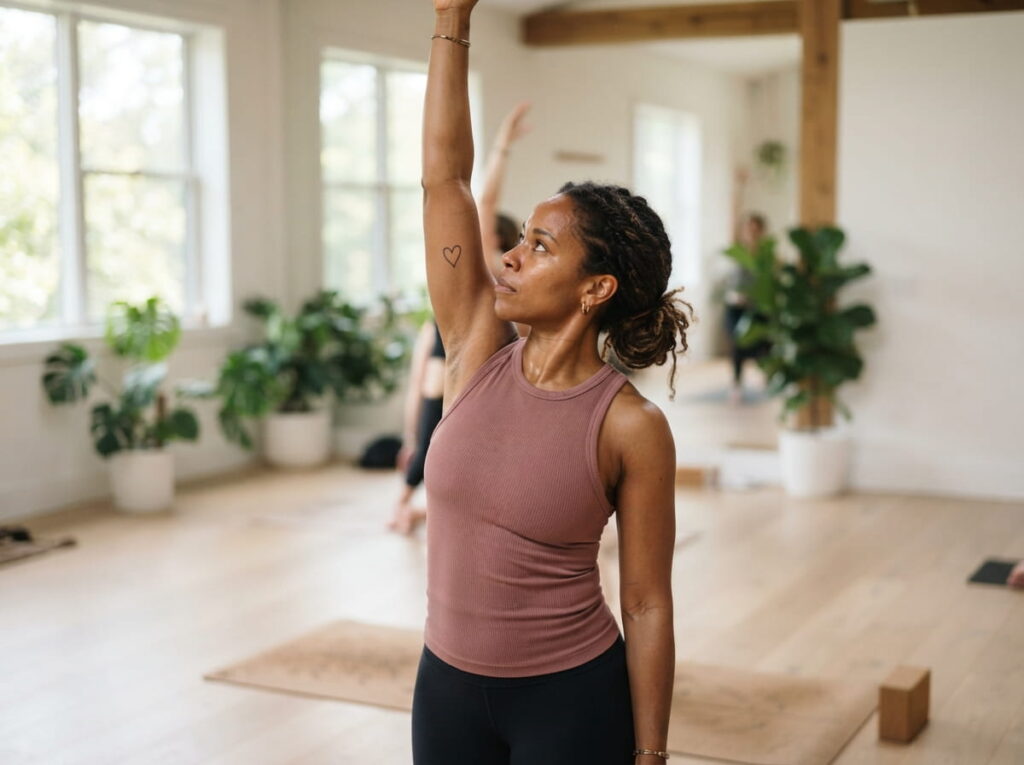
A heart is often called too basic. In practice, a simple shape with open space is easier to keep readable.
An outline with open space inside leaves little to run together. The inner bicep is soft and easy to cover with a sleeve, so you choose when it shows. The skin close to the armpit can be more sensitive, so keep the heart toward the middle of the arm.
Ask for a heart with slightly uneven curves rather than a stamped, perfectly symmetrical one. It feels hand-drawn and personal, which is the point of a small tattoo in the first place.
The one thing to remember: open space inside a shape gives your tattoo room to age. Simple outlines are usually the easiest to keep readable.
10. A Little Sun Symbol at the Base of the Neck
Wear a thin chain at the base of your neck and a small sun can look like part of the jewelry.
Keep the design to a circle with five to seven short rays, spaced wide enough that none touch. Tightly packed rays leave little margin. Ask your artist to center it slightly above the bump of the spine so it sits straight when your hair is up.
This spot gets sunlight, collars and hair products. As noted above, the AAD says UV light can fade some tattoo inks, and recommends broad-spectrum, water-resistant sunscreen of SPF 30 or higher on exposed tattooed skin (AAD). While the tattoo is still healing, follow your artist’s instructions about sun and sunscreen.
- Ask your artist: “When can I start using sunscreen on it?”
11. A Small Paw Print or Pet Silhouette Just Above the Elbow
A pet tattoo carries more weight than most, so the design should be recognizable at a glance.
Choose one clear shape: a paw print with four toes and a pad, or a simple side profile showing their ears. Skip whiskers and fur texture, because fine detail leaves little room for error in a small tattoo.
The skin just above the elbow moves less than the joint itself. Ask your artist to place it on the outer side if you want it visible, or the inner side if you want it kept private.
If it is a memorial piece, give yourself extra time before booking. Strong emotion can rush decisions, and a tattoo you wait a few weeks for is usually one you are glad you waited for.
12. A Slim Olive Branch Along the Side of the Wrist
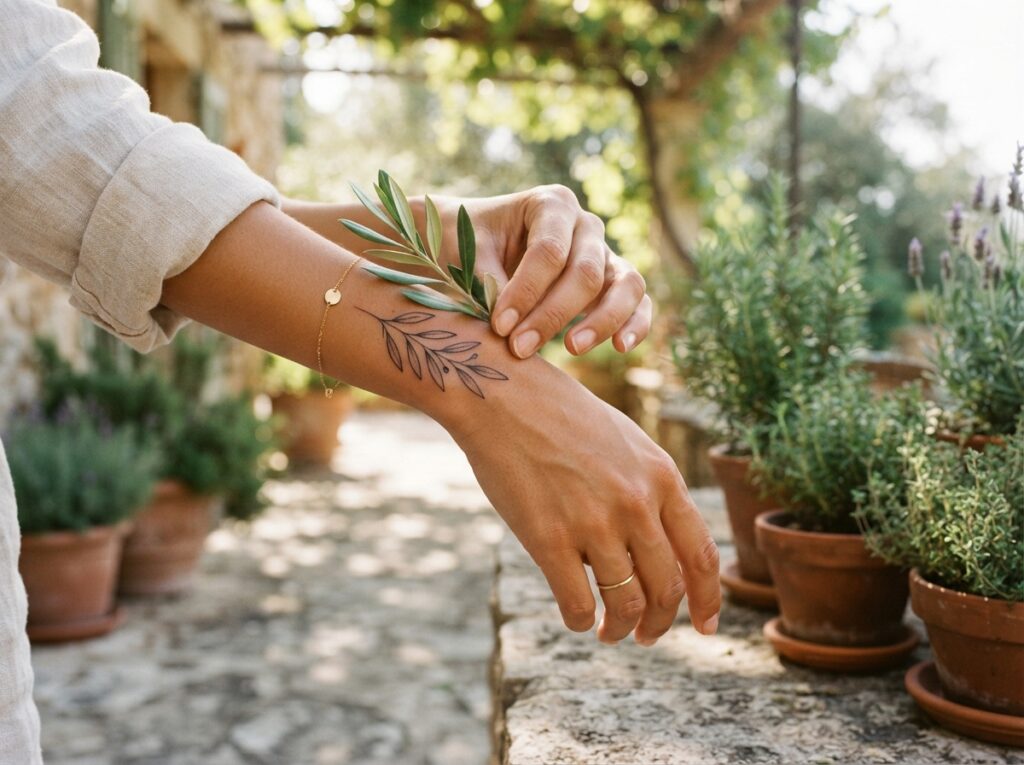
An olive branch is a good pick when you want something graceful without much fuss.
It runs along the side of the wrist like a thin line with a few leaves on each side. The shape is naturally spaced, which suits a small tattoo. It also appeals to people who like meaning behind a design, since the olive branch is a long-standing symbol of peace.
- Keep leaves to six or eight, each with a clear gap.
- Let the stem follow the tendon line so it looks natural when your hand moves.
- Use one line weight for the whole branch.
Questions to ask at the consultation:
- Can I see the stencil on my wrist before you start?
- Can I bend and turn my hand with the stencil on to check the flow?
- How do you recommend handling touch-ups for fine lines in this spot?
Frequently Asked Questions
How small is too small for a tattoo? There is no universal number. It depends on the design, the body area and the artist’s skill. A useful rule is that every line and gap should stay clearly separate even if it softens a little. If your design needs tiny details to make sense, make it larger or simplify it.
Do small tattoos fade faster than big ones? Sun exposure is the cause of fading that the AAD specifically names. Fine lines and tiny details can simply show change sooner, because there is less ink and less margin for error.
Can I put sunscreen on a new tattoo? Follow your artist’s aftercare instructions for the healing period. Once the tattoo is healed, the AAD recommends sunscreen of SPF 30 or higher on tattooed skin that is exposed to the sun.
What if my skin reacts to the tattoo? The AAD says reactions can happen right away or years later. See a board-certified dermatologist if your tattooed skin changes in any way.
Conclusion
The best small tattoos are rarely the cleverest ones. They have room to age, a spot you like looking at, and an artist you trust to keep the lines steady.
If you are still sorting through small tattoo ideas for women, start with the two or three that stayed on your mind the longest. Test them with a temporary tattoo or a paper cutout, check the placement in a mirror, and give yourself a few weeks before booking. A short wait costs nothing, and it is one of the easiest ways to protect yourself from regret.
Your pre-booking checklist
- I still like the design after a few weeks.
- I tried the size and spot with a temporary tattoo or paper cutout.
- The lines have clear gaps and no tiny detail.
- I have chosen an artist and checked their hygiene practices and healed work.
- I have asked about aftercare and sun protection for this spot.
- I have checked the spot for moles and asked a dermatologist if unsure.
Sources
- American Academy of Dermatology Association, Caring for tattooed skin
- Mayo Clinic, Tattoos: Understand risks and precautions
- Removery, Tattoo pain chart (informal survey of tattoo artists and enthusiasts, not a clinical study)
This article is for general inspiration and information and is not medical advice. For any skin concern, speak with a board-certified dermatologist, and follow your tattoo artist’s aftercare instructions.

Leave a Reply