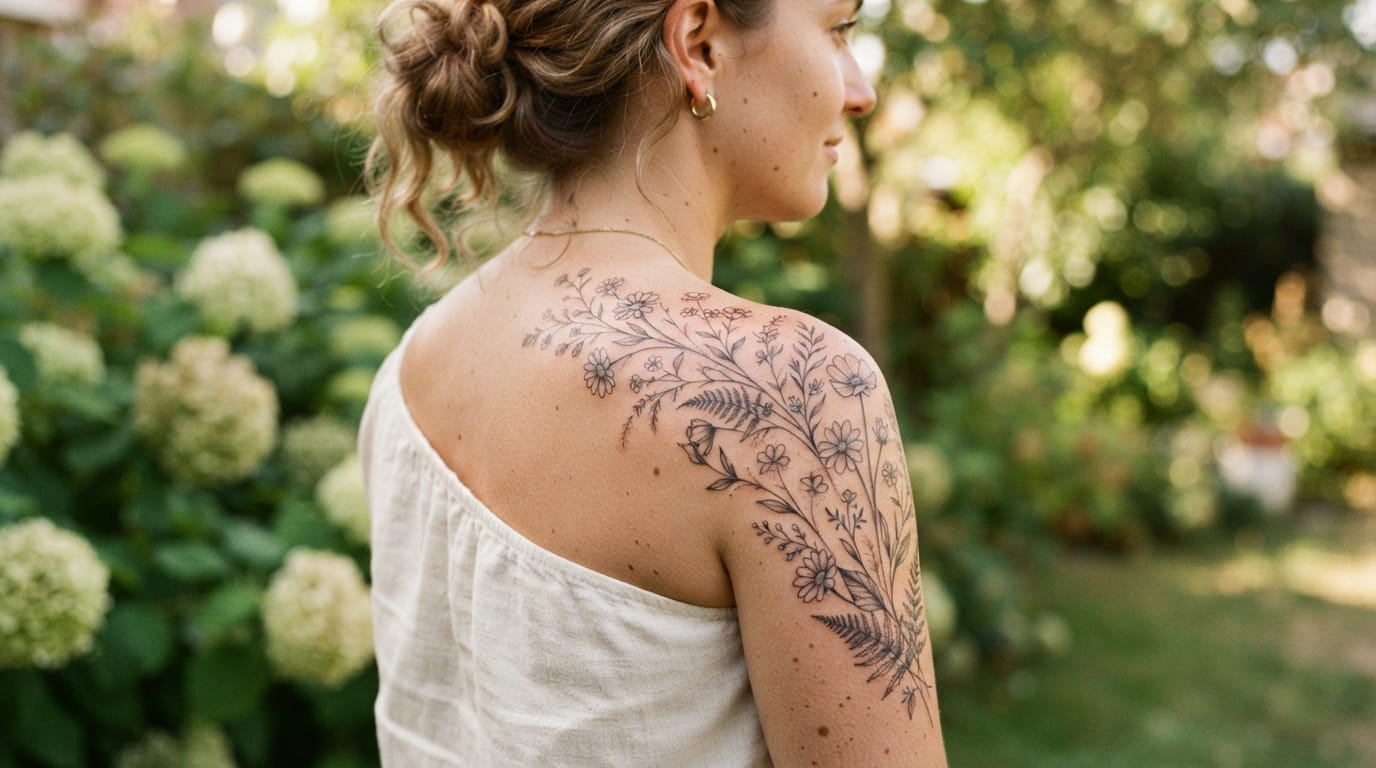
Most people don’t walk into a tattoo shop already knowing exactly what they want. They walk in with a feeling, a flower they can’t stop thinking about, or a photo saved from a hike two summers ago that they never deleted.
That’s the thing about wildflower tattoo ideas. They aren’t one style. A wildflower can sit as a single stem the size of a fingernail, or it can spread across a whole thigh like an actual field. The flower stays the same. The scale and the linework change everything about how it reads.
If you’ve been stuck between “something small” and “something that actually says what I mean,” this list is built to show you that range. Ten versions of the same flower, from the quietest tattoo you’ll own to the one strangers ask about at the pool.
None of these need a big meaning behind them to be worth getting. Sometimes you just like the shape of a petal.
- 1. The One-Stem Wildflower, Placed Where You’ll Actually See It
- 2. A Loose Wildflower Bouquet Behind the Ear or Along the Collarbone
- 3. Your Birth Month Wildflower, Paired With Its Latin Name
- 4. A Wildflower Chain Wrapped Around the Wrist or Ankle
- 5. The Pressed Flower Look, Like a Bloom Under Glass
- 6. A Wildflower Cluster Climbing the Spine
- 7. A Watercolor Wash Bloom With Soft, Bleeding Color
- 8. A Botanical Illustration Style Wildflower, Roots and All
- 9. A Full Wildflower Meadow Scene Across the Thigh or Forearm
- 10. Bold Blackwork Wildflower With Heavy Linework and Negative Space
1. The One-Stem Wildflower, Placed Where You’ll Actually See It
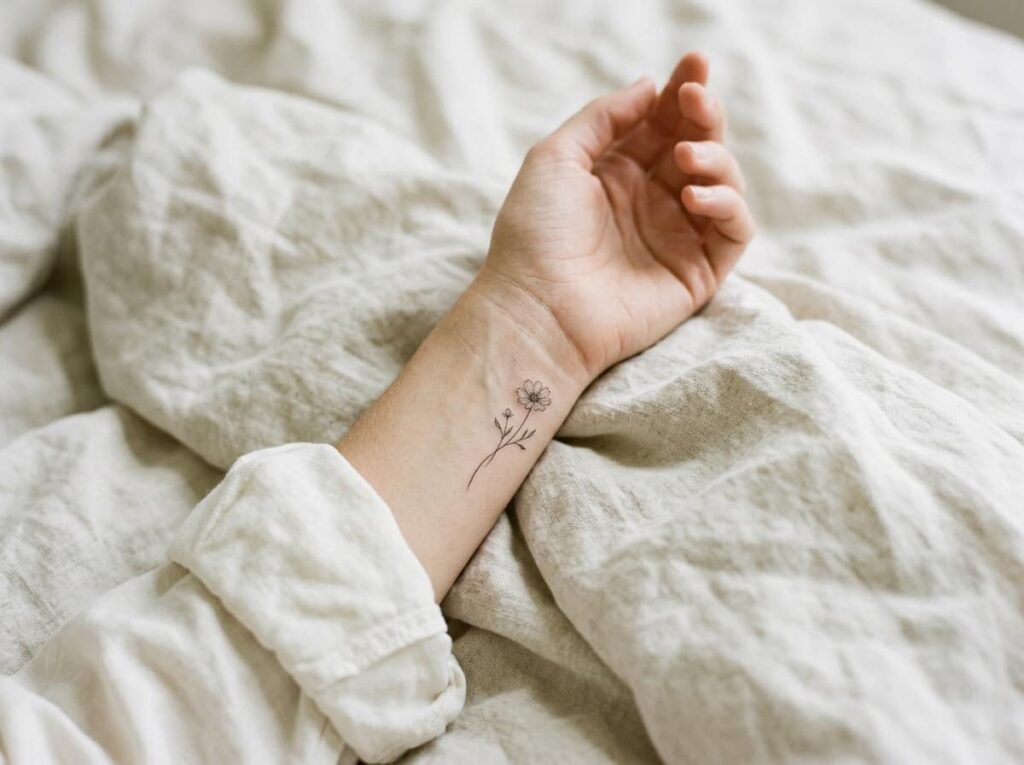
A lot of first tattoos end up bigger than they need to be, because people assume size equals meaning. A single stem does the opposite. One bloom, one stem, maybe two leaves, with enough white space around it to let the shape breathe. This size also ages better than people expect.
Fine lines packed into a crowded cluster can blur after ten years, but a clean single stem holds its edges. Inner wrist, the side of an ankle, or just above the elbow are the spots that catch your eye without turning into a whole statement piece. It’s the tattoo you forget about until you glance down.
💡 Quick Tip
Ask your artist to draw the stem slightly thicker than the petals. It keeps the whole flower readable once the fine lines settle under the skin.
2. A Loose Wildflower Bouquet Behind the Ear or Along the Collarbone
Three or four small blooms grouped behind the ear or across the collarbone read as soft without looking plain. Stack a daisy, a small sprig of baby’s breath, and one slightly bigger flower so your eye has somewhere to land first instead of scanning flat space. The collarbone curve actually helps here, it gives the cluster a natural line to follow. The one catch is the spot itself. Thin skin over bone tends to feel sharper than fleshier areas, so most artists will mention that before you sit down, not after.
3. Your Birth Month Wildflower, Paired With Its Latin Name
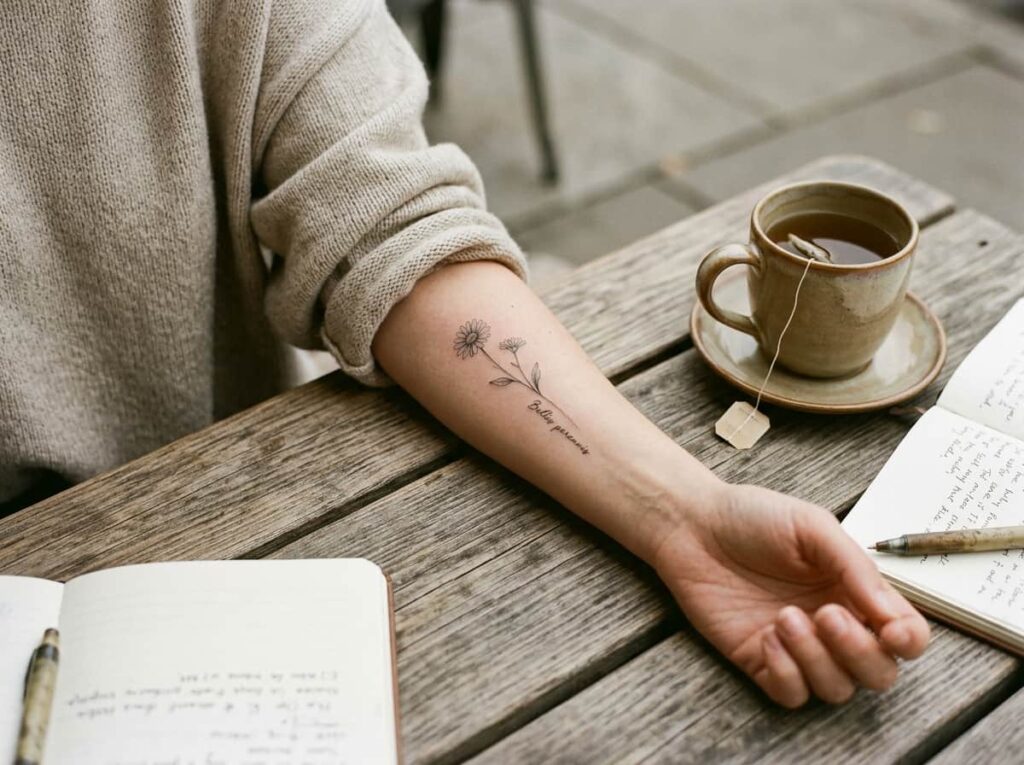
Look up your birth month flower before you search for reference photos. It narrows the whole decision down fast, and it gives the tattoo a reason that’s yours even if nobody else ever asks about it.
Most artists can write the Latin name in a thin, slightly uneven script underneath the bloom, which reads as handwritten instead of printed. Keep the text small. A long Latin name crammed under a tiny flower is the one thing that can make a delicate tattoo look cluttered instead of intentional.
| Birth Month | Wildflower & Meaning |
|---|---|
| March | Daffodil, new beginnings |
| April | Daisy, loyal love |
| September | Aster, patience |
4. A Wildflower Chain Wrapped Around the Wrist or Ankle
Think of the chain you’d actually braid by hand if you were sitting in a field, not a stiff repeating pattern. A mix of daisy, chicory, and queen anne’s lace linked loosely gives the design movement instead of looking stamped on.
The trick is spacing. Too tight and it reads as a solid band from a distance, too loose and it falls apart visually. A good artist will sketch the gaps on your actual wrist before tattooing, since everyone’s wrist bone sits a little differently.
5. The Pressed Flower Look, Like a Bloom Under Glass
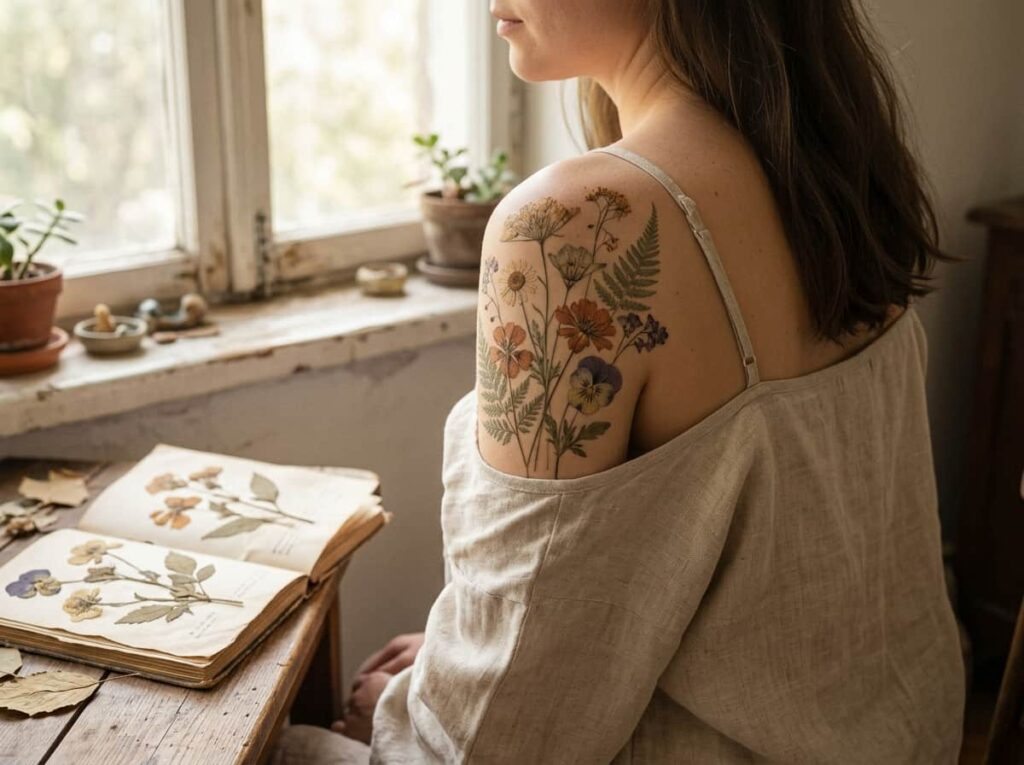
People assume a pressed flower tattoo needs shading to look real, and that’s actually backwards. The flat, slightly dried look comes from thin, even linework and almost no shading at all, which is the opposite of what most tattoo styles lean on. It takes a specific kind of reference photo to pull off well.
Find a photo of an actual pressed flower, not a painting of one. The flattened, slightly papery petals are the whole point.
Ask for uniform line weight with no shading. Any shadow pulls it back toward a realistic flower instead of a pressed one.
Let a petal or two overlap and flatten slightly, the way a real flower warps a little under pressure.
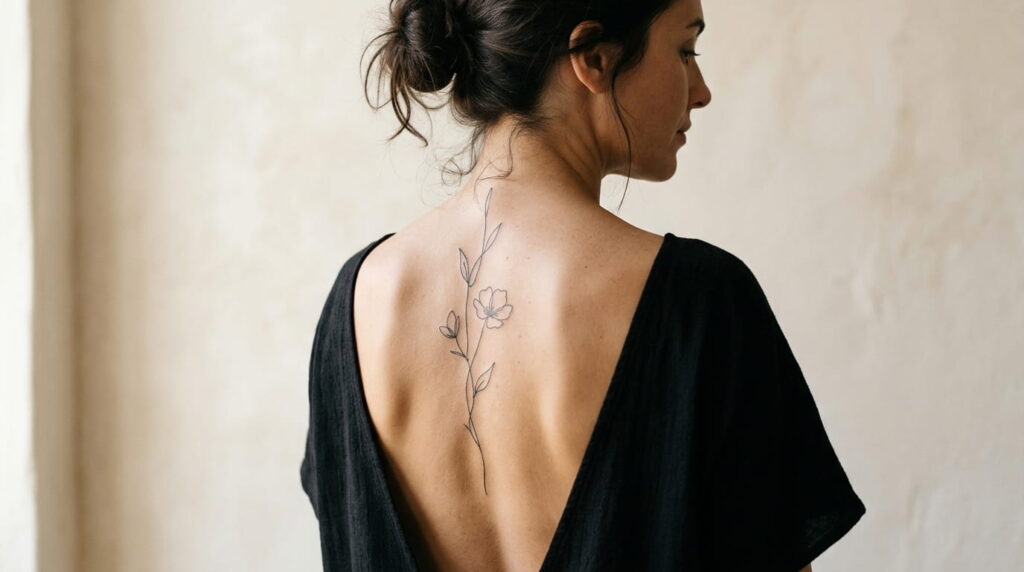
6. A Wildflower Cluster Climbing the Spine
The spine looks straight until you actually tattoo it. Every curve from the base of the neck to the lower back becomes part of the design, whether you planned for it or not.
A wildflower cluster that follows that curve, with each bloom slightly smaller as it moves down, uses the shape instead of fighting it.
Two things most artists mention before this placement: pain changes a lot by exact spot, with the bonier areas near the neck and tailbone reading sharper than the fleshier middle. Long sessions also get harder the lower the design runs, so two sittings is common instead of one.
Split a full spine piece into two sessions.
Ask to see the stencil both standing and bent forward.
Booking one long sitting for a full-length spine piece.
Linework so fine it disappears into the spine’s natural shadow.
7. A Watercolor Wash Bloom With Soft, Bleeding Color
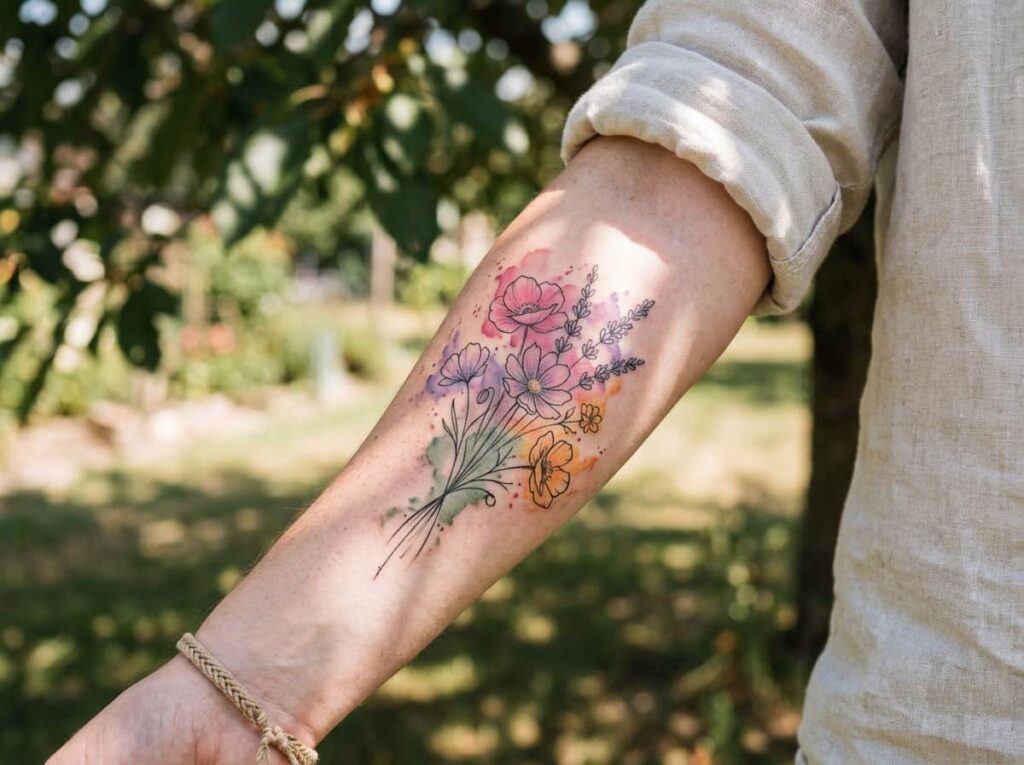
A watercolor wildflower reads less like a tattoo and more like something painted straight onto skin, especially when the color bleeds a little past the linework instead of stopping at a hard edge.
The tradeoff is longevity. Color washes fade faster than solid black work, and bright washes can look patchy after a few years in direct sun.
Bring two separate references to your appointment: one for the flower shape, one for the color blend. Combining them into a single busy photo makes it harder for the artist to separate the two.
What to bring to your appointment
8. A Botanical Illustration Style Wildflower, Roots and All
Roots, stem nodes, the faint fray at the edge of a petal, old botanical textbook illustrations include all of it, not just the bloom itself. Translating that into a tattoo means showing the whole plant pulled up out of the ground instead of a flower floating alone on skin.
This style leans on precise, confident linework more than shading, so it holds up well over time. It also reads as more serious and less decorative, which matters if you want something deliberate rather than just pretty.
Showing the root system is what separates a botanical illustration tattoo from a plain flower tattoo. Don’t let an artist talk you into skipping it to save time.
9. A Full Wildflower Meadow Scene Across the Thigh or Forearm
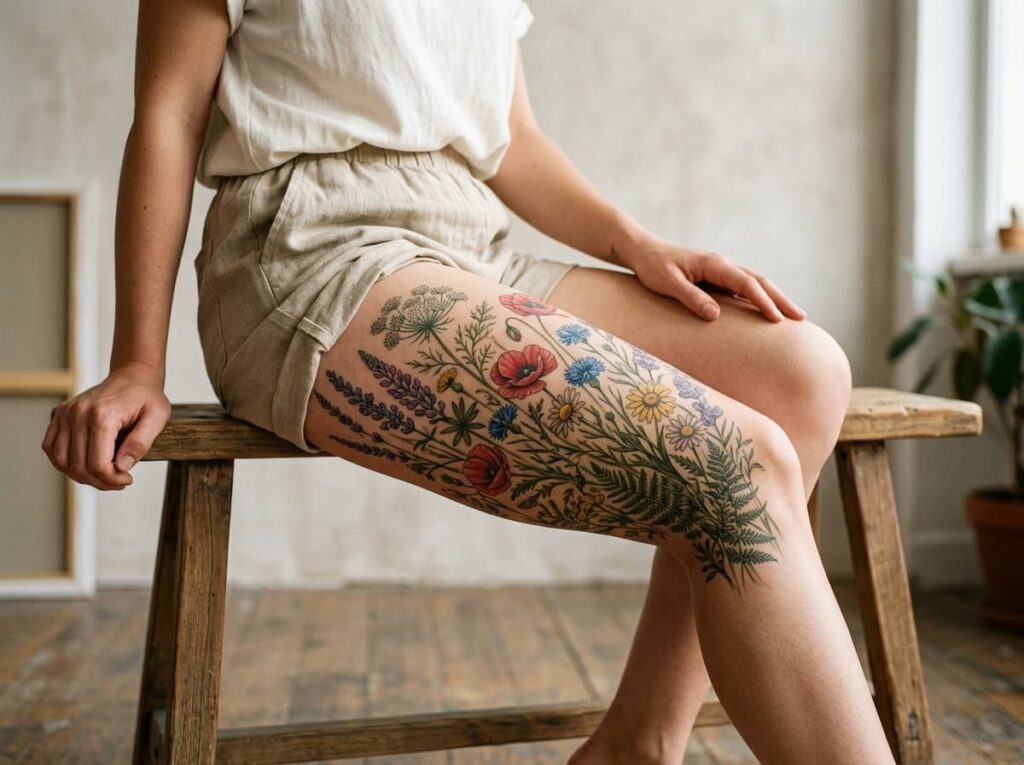
A wildflower meadow covering the outer thigh or forearm takes longer to plan than almost anything else on this list, because it’s really ten or twelve small flowers working together as one scene instead of a single centered image.
Depth matters more than detail here. A few blooms drawn larger and closer, with smaller ones fading toward the edges, reads as an actual field instead of a flat pattern. Even spacing, where every flower is roughly the same size, is the fastest way to make a meadow piece look like wallpaper.
- ▸Vary flower sizes from front to back, not side to side.
- ▸Add at least one tall grass or stem breaking the line of blooms.
- ▸Leave negative space between clusters so the eye has somewhere to rest.
10. Bold Blackwork Wildflower With Heavy Linework and Negative Space
Thin linework and bold blackwork can start from the same wildflower sketch and still end up looking like two different tattoos. Blackwork leans on thick, confident strokes and deliberate negative space instead of fine detail, which gives it that graphic, almost poster-like look.
This version also ages the best of anything on this list. Thick black lines hold their shape for decades in a way fine lines eventually can’t match, worth weighing if you’re torn between delicate and bold.
Simplify the petal count. Fewer bold petals read clearer than many thin ones.
Let negative space do real work instead of filling every gap.
Cramming botanical detail into thick linework, it muddies fast.
Going too small, bold linework needs room to hold its shape.
Conclusion
Ten tattoos, one flower, and barely any of them look alike once you line them up. That’s really the point. Wildflower tattoo ideas stretch across almost any size or style because the flower itself is forgiving, a tiny sprig behind the ear says just as much as a full meadow scene across the thigh, just in a different volume.
The version that fits you was probably already somewhere on this list, even if it wasn’t the one you expected. Save this list before your next consultation, so you can pull it up and point instead of trying to describe a flower from memory.
Before your consultation
Leave a Reply