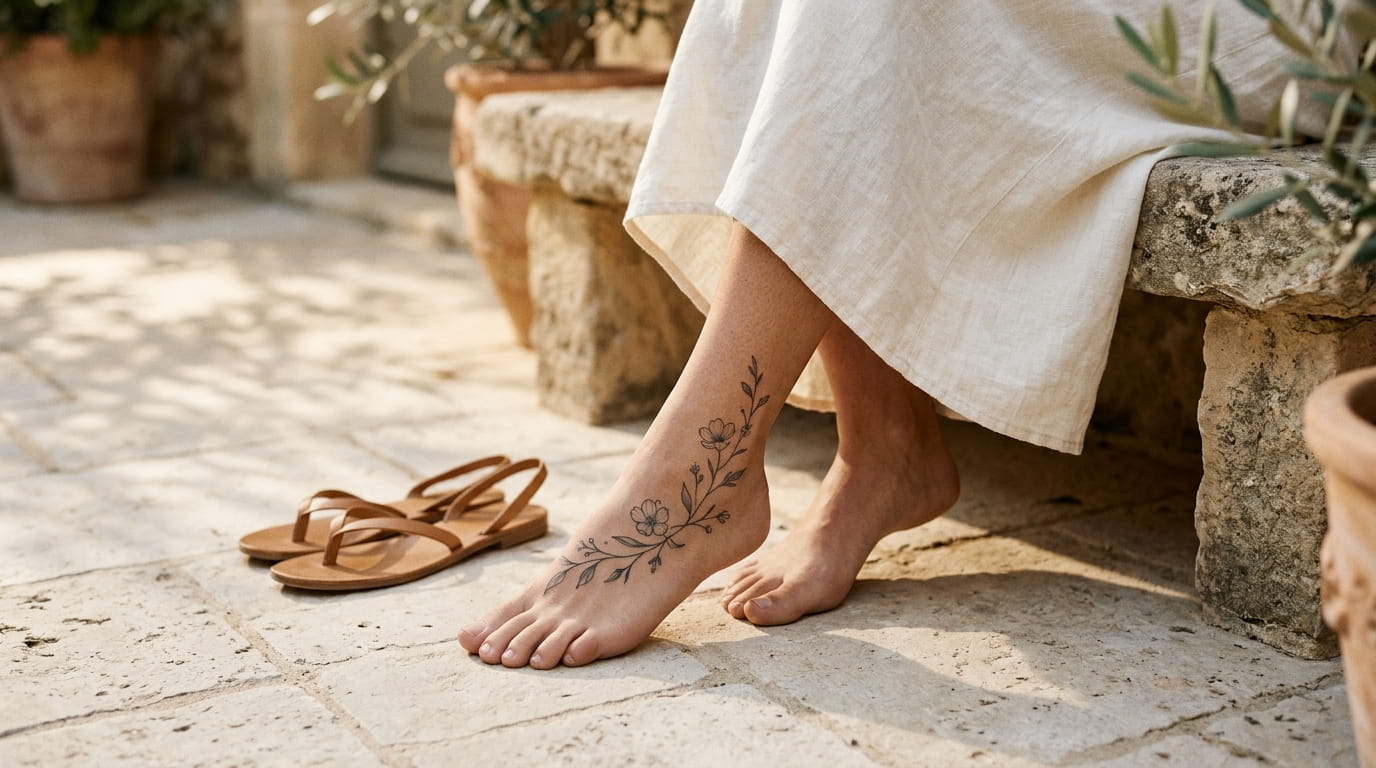
You’re already thinking about this in June, not January. Sandal weather means your feet are visible for months at a stretch, and a foot tattoo that looked sharp in the artist’s portfolio can turn into a smudge by August if nobody warned you about placement.
Most lists of foot tattoo ideas treat the foot like any other patch of skin. They don’t mention that the top of your foot moves every time you flex, that the arch stretches when you walk barefoot on sand, or that a side placement near your ankle bone gets rubbed raw by stiff shoe edges before it even finishes healing.
This list skips the vague inspiration and gets specific. Ten foot tattoo ideas, broken down by exactly where they sit on your foot and what that placement means for healing, pain, and how the design will actually look a year from now, not just the day you walk out of the studio.
1. A Vine That Climbs From Your Toes To Your Ankle Bone
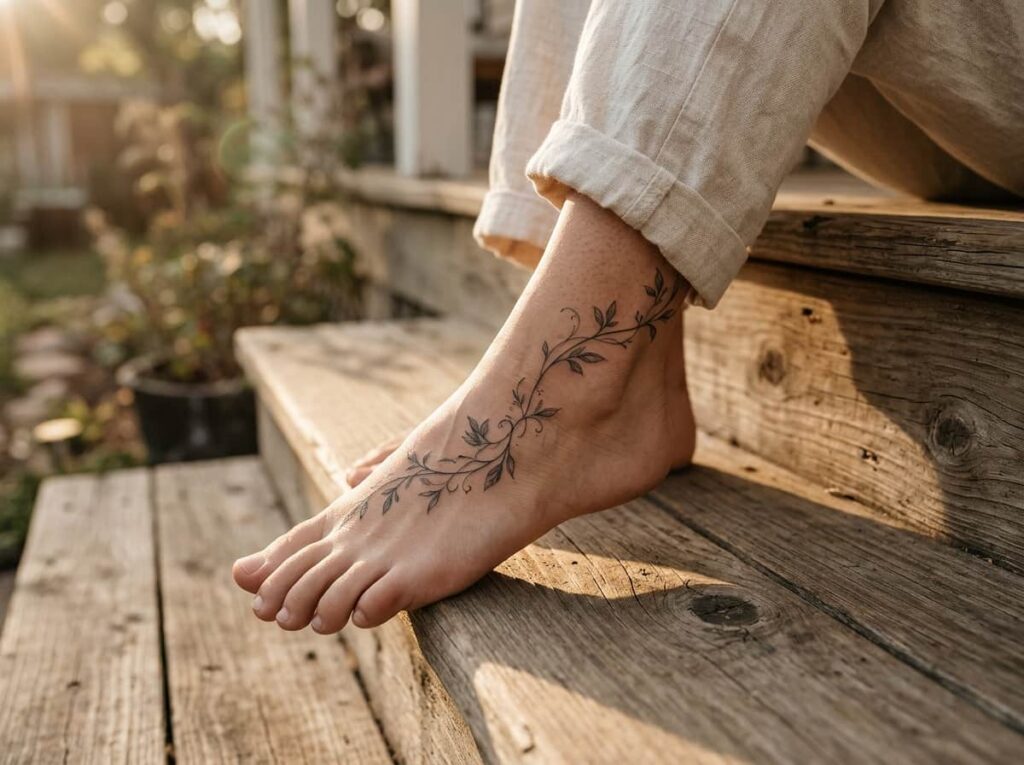
A single vine starts between your first two toes and winds up and over the bridge of your foot, thinning out as it nears your ankle bone. Thin lines like this hold their shape well here because the skin stays fairly flat across the top of the foot.
A few things make this placement work:
- Keep the line width under two millimeters so it doesn’t blur as it heals
- Ask your artist to taper the vine rather than end it abruptly
- Leave space around your tendons so the design moves with your foot instead of against it
Expect it to feel sharp right over the bone, especially near the ankle.
2. Keep Side-Of-Foot Tattoos Thin, Or They Blur Fast
Side-of-foot tattoos blur faster than almost any other spot on the body, and most people don’t find out until a year in. The skin along the outer edge gets constant friction from shoes, socks, and just walking, which pushes ink to spread under the surface.
Bold linework or solid fill in this spot tends to soften into a smudge within two or three years. Fine single-needle lines survive longer, especially in a simple shape like a small arrow, a thin wave, or one word in a narrow script.
If this placement matters to you, bring reference photos and ask your artist directly how they plan to compensate for the friction.
💡 Quick Tip
Ask for single-needle work on the side of the foot. Thicker lines here almost always spread within two or three years.
3. Scatter A Tiny Constellation Across Your Toes
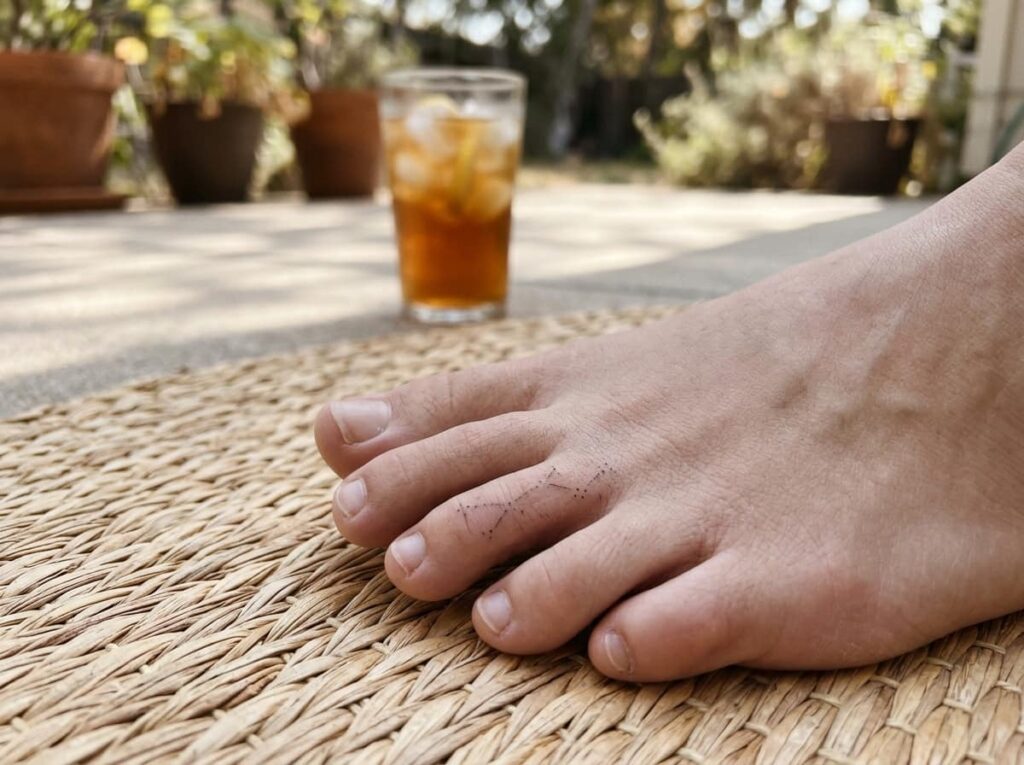
Toe tattoos heal fast because the area is small, and a scattered constellation across two or three toes reads as delicate without needing a big session. Most people finish in under thirty minutes.
The catch is durability. Toes flex constantly and the skin there is thinner than almost anywhere else on your body, so dots and fine lines fade quicker than they would on your arm or back.
Do this:
- Space dots at least a quarter inch apart so they don’t merge into a blob
- Pick one star slightly larger as a focal point
Skip this:
- Tiny script or numbers between the dots, since toe skin rarely holds detail that fine
Space dots a quarter inch apart so they stay distinct.
Make one star slightly larger as a focal point.
Tiny script or numbers between the dots.
Solid fill stars, which blur fastest on toes.
4. Center A Fine-Line Mandala Right On Your Arch
A mandala needs room to breathe, and the arch is one of the few flat, stable spots on the foot where a symmetrical design won’t warp when you walk.
The rule that matters most here is size. Go too small and the inner detail closes up within a year as the lines settle. Go too large and the edges creep onto the sides of your foot, where healing gets harder.
- Start with a design roughly two inches across
- Center it where your foot naturally curves
- Let your artist scale the detail level to match that size, instead of shrinking a design built for a bigger canvas
Start with a design roughly two inches across.
Center it where your foot naturally curves.
Let your artist scale the detail to that size, not shrink a bigger design down.
5. Split A Sun And Moon Across Two Toes
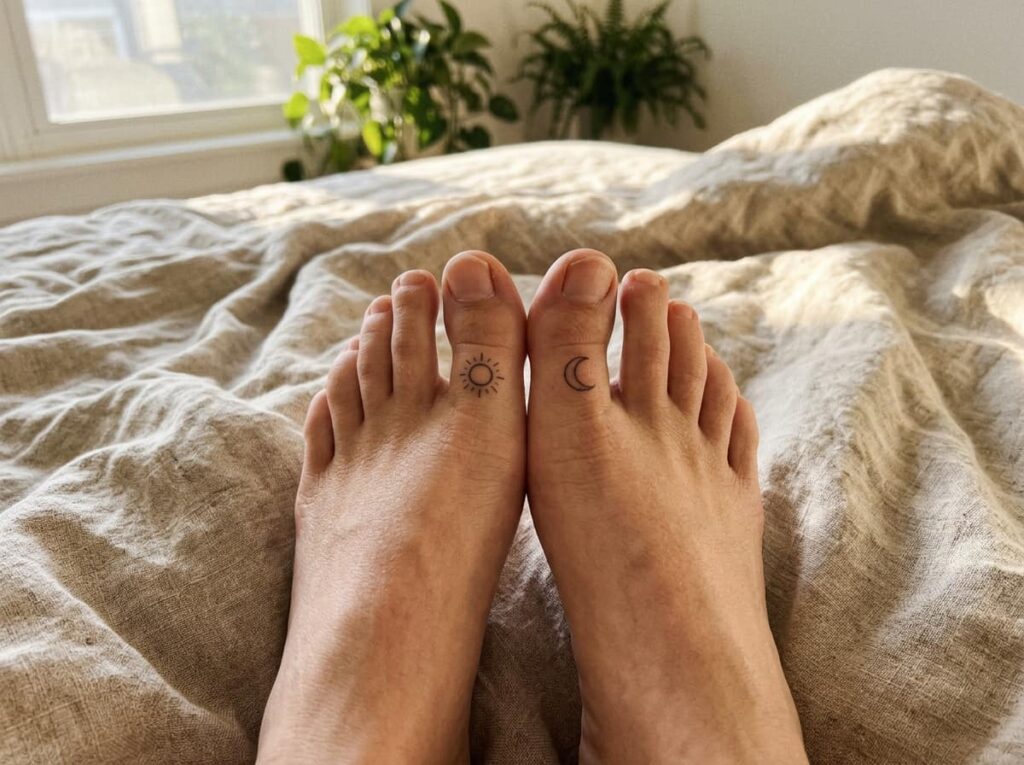
A sun on one big toe and a moon on the other is a classic pairing, but the two toes don’t take ink the same way. Big toes have more flat surface, so fine shading on the sun tends to hold up better over time. A moon placed on a second toe sits on a smaller, curved surface, which works better as a simple line design than anything with shading or fill.
Matching the complexity to each toe’s shape, rather than copying one design onto both sides, is what keeps this pairing looking intentional instead of lopsided a few years in.
6. A Single Word Running Along Your Outer Arch
Word tattoos on the outer arch read clean when the script matches the space. Pick a word short enough to curve naturally along the foot, usually four to seven letters, so the artist isn’t forced to shrink the lettering until it loses shape.
Before your appointment, bring a few things so the session goes smoothly and the placement lands right the first time.
- A photo of your foot from the angle you’ll actually see it, standing and looking down
- Two or three font references, not just one, so your artist has range to work with
- A note on whether you want the word to curve with your arch or sit in a straight line
Skip anything smaller than a quarter inch tall. It will blur past readability within a few years.
What to bring to your consult
7. A Minimalist Butterfly Just Above Your Toes
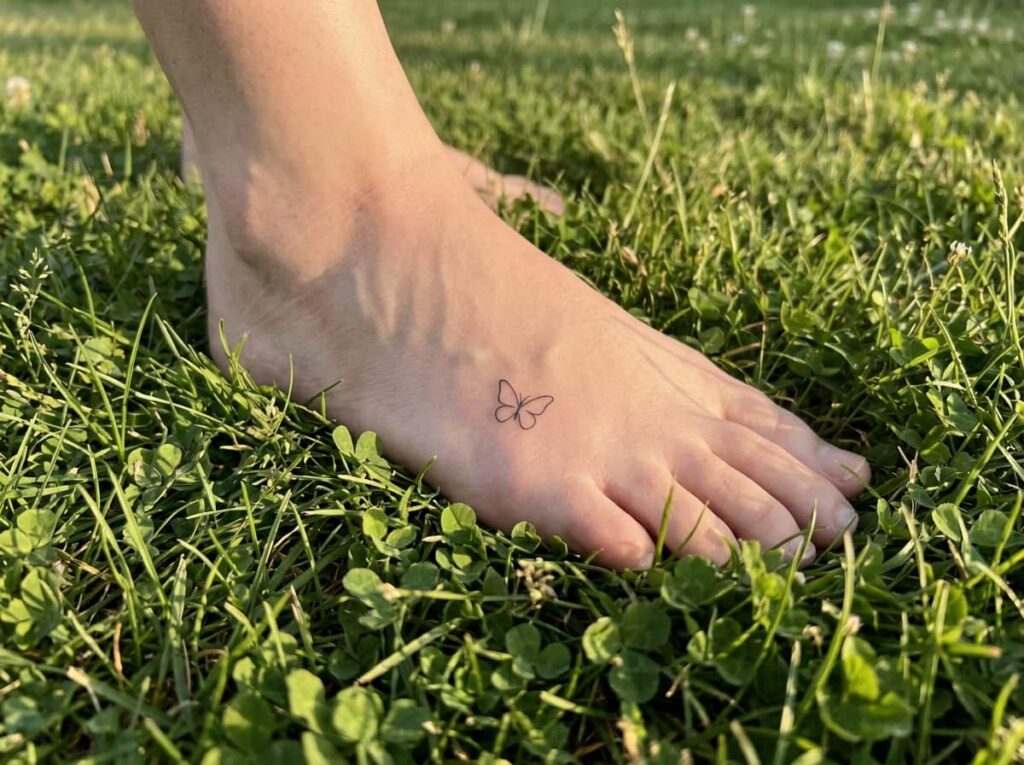
Picture the space right where your toes meet the rest of your foot. It’s small, it’s flat, and it’s one of the few spots on the foot that doesn’t shift much when you walk, which makes it a steady home for a simple design.
A minimalist butterfly here works because the wings can stay small without losing their shape. Keep the linework under two millimeters and skip shading entirely. Shading in this exact spot tends to soften into a grey smudge faster than almost anywhere else on the foot, since the skin is thin and takes a lot of daily friction from shoes.
Skip shading just above the toes. Thin, solid lines hold their shape here far longer.
8. A Row Of Tiny Matching Symbols Across All Five Toes
People often assume a toe tattoo and a top-of-foot tattoo heal the same way, since they’re only an inch or two apart. They don’t. Toes move independently with every step, while the top of the foot moves as one flatter surface, and that difference changes how a repeated symbol across all five toes will age.
A row of small matching symbols, like tiny hearts or stars, looks crisp on day one. Whether it stays that way depends heavily on which surface it’s sitting on.
| Toe Tattoo | Top-of-Foot Tattoo |
|---|---|
| Heals faster, smaller area | Heals slower, more surface involved |
| Higher chance of fading per toe | More even fading across the design |
| Best for single small symbols | Best for connected or larger designs |
| Toe Tattoo | Top-of-Foot Tattoo |
|---|---|
| Heals faster, smaller area | Heals slower, more surface involved |
| Higher chance of fading per toe | More even fading across the design |
| Best for single small symbols | Best for connected or larger designs |
9. A Watercolor Wash That Fades Toward Your Ankle
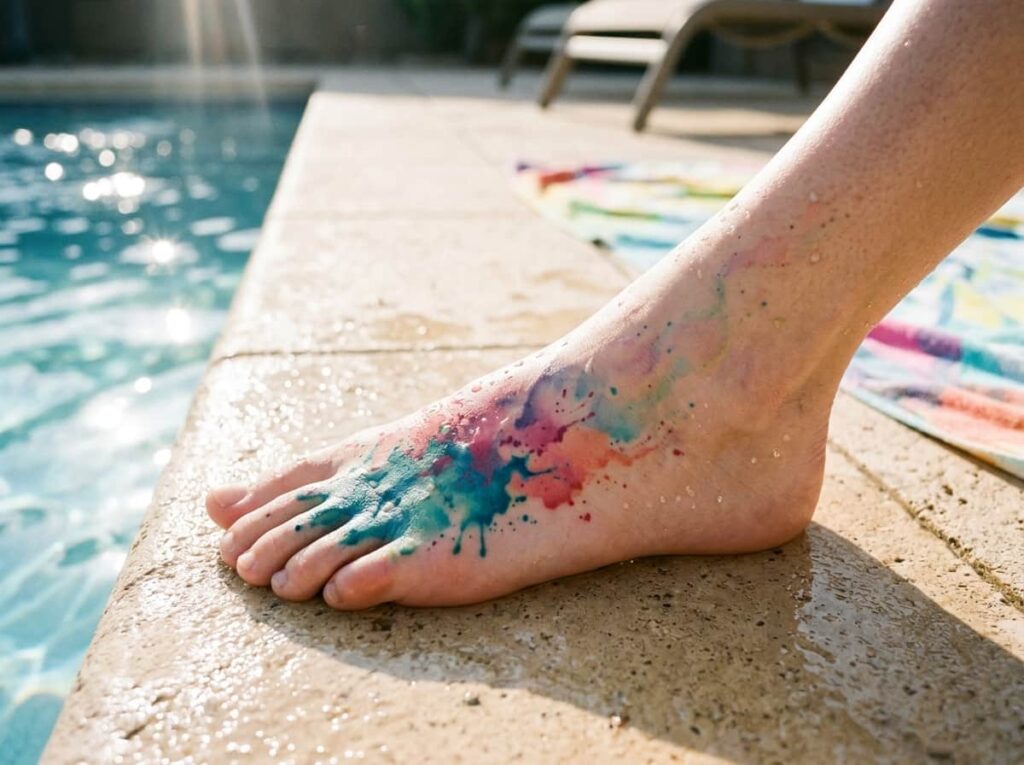
Watercolor tattoos on the foot age differently than they do on the arm or shoulder, mostly because of how often your foot gets sun exposure in sandals. A wash that starts bold at the toes and fades toward the ankle can still look soft and intentional a year or two later, but only if your artist layers the color with that fading in mind from the start.
The biggest mistake here is treating the fade as an afterthought instead of planning the pigment density around it from the first session.
Bold color at the toes, soft fade starting near the arch.
Fade softens further on its own, reading as a deliberate wash rather than a mistake.
10. An Anklet-Style Band That Wraps Into A Top-Of-Foot Design
This one gives you two placements in a single piece. A thin band wraps around the ankle like jewelry, then a small extension, maybe a charm shape or a single flower, carries onto the top of the foot. It reads as intentional rather than like two separate tattoos stuck together.
A few things worth knowing before you book this one:
- It takes longer to tattoo than either placement alone, usually a full session rather than a quick add-on
- The ankle band portion tends to fade slightly faster since it sits closer to constant shoe friction
- It pairs well with simple sandals, since the design is visible from nearly every angle
- ▸Takes a full session rather than a quick add-on.
- ▸The ankle portion fades slightly faster from shoe friction.
- ▸Pairs well with simple sandals since it’s visible from most angles.
Final Thoughts
The best foot tattoo ideas come down to matching the design to how that part of your foot actually moves, heals, and holds up to daily wear. A mandala needs a flat arch. A watercolor wash needs pigment planned around fading. A word needs enough space to stay readable past year one.
Bring these foot tattoo ideas to your consult as a starting point, not a final answer. A good artist will adjust size, line weight, and placement based on your actual foot shape, not just the reference photo.


Leave a Reply